

Real-World AI Use Cases in Manufacturing
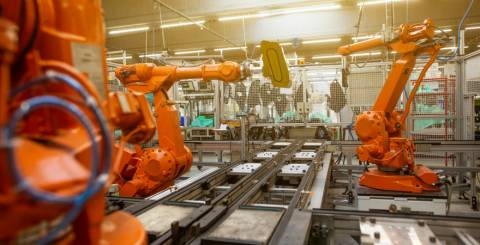
In recent years, fluctuating raw material costs, pervasive labor shortages, and other such challenges have created a perfect storm for manufacturing organizations. In this market, outdated practices such as preventative equipment maintenance, visual inspections, etc. are no longer sufficient. To do what, you ask. To enable efficient, high-volume production. To survive these conditions, manufacturers need to reimagine their plants' operation strategies.
Rather than running their facilities on disjointed technologies, these companies need end-to-end visibility and agility to adjust their schedules in real time. Besides that, they need continuous and automated improvement of operations to thrive in the long run. And that is exactly where artificial intelligence (AI) comes into the picture. It can analyze operational data almost in real-time, helping you to tap into valuable intelligence from data points generated across your manufacturing plant every day. AI also stands to help such companies detect anomalies and predict machine failures before they happen. They can also intelligently create efficient plants that can scale production while maintaining high yields.
In this blog, I will discuss some of the prominent use cases of AI’s application in the manufacturing industry.
The Role of AI in Modern Manufacturing
The scope of what this tech can do in this sector is abundant. Let us begin with AI engines: they can convert plant data into real time actionable intelligence throughout the manufacturing process. Machine learning models running on IoT devices can predict failures before they happen and adjust operations schedules accordingly. Feeding real time data about equipment vibration, heat, etc. into ML models is used to deliver predictive maintenance. So, you can completely avoid expensive downtime. Machine vision running on AI can inspect products on the assembly line for structural defects as well as surface blemishes. This helps identify manufacturing errors or keep products inconsistent from making their way into shipping. Through smart technologies and systems integration, manufacturers can take production from reactive shop floor thinking to a proactive fully automated production process.
Most Impactful AI Use Cases in Manufacturing Sector
AI is reshaping manufacturing by helping organizations move beyond traditional automation toward smarter, data-driven operations. From predictive maintenance and quality inspection to production optimization and supply chain intelligence, AI is enabling manufacturers to improve efficiency, reduce costs, minimize downtime, and make better decisions.
Listed are some of the important use cases;
- Advanced quality control: AI solutions make use of computer vision models and deep learning algorithms to analyze products for defects at incredible speeds. And this can be done right on the production line itself. Powerful cameras take high-res photos of each unit as they pass by. They can then be assessed by AI software to identify microscopic cracks, misalignment of components, etc. Another method of AI quality control can include assessing real time sensor data such as acoustic emissions, temperature changes, to find structural or internal defects as they occur during the production process.
- Real-time decision making: This bit also needs edge computing with ML models deployed locally on the shop floor. In a conventional manufacturing set-up, plant managers may look at hourly or daily operational reports well after a problem has occurred. With AI, analytics continuously monitor data streamed from machines, production line equipment, etc. If conditions start trending outside predetermined boundaries, the AI scores the event and responds immediately.
- Monitor and adapt production processes: AI can also assist with the oversight of production facilities by analyzing inputs, surrounding environments, etc. on an ongoing basis. ML software can run in closed loop control to consider factors such as the quality of raw materials being used, humidity levels, etc. When changes are perceived in the process the system will self-adjust operational parameters on the fly.
- Accelerated product design: AI helps designers develop products faster with generative design and simulation algorithms. Generative AI takes explicit constraints fed by engineers and autonomously outputs thousands of CAD designs in minutes. It does so by exploring design permutations that often result in organic geometries beyond what engineers would normally create. AI-powered physics-based simulations allow engineers to virtually test product designs by putting prototypes through virtual operating conditions.
Final Thoughts
AI is transforming manufacturing from reactive operations into intelligent, proactive, and adaptive ecosystems. By enabling predictive maintenance, real-time decision-making, quality control, process optimization, and accelerated product development, AI helps manufacturers improve efficiency, reduce downtime, and enhance productivity. Organizations that strategically integrate AI can build resilient, scalable, and future-ready manufacturing operations capable of sustained growth. I suggest that now you start looking for an industry expert to fortify your operations with AI-driven digital manufacturing solutions.
Similar Articles
Anthropic, the American company behind Claude, is among the most closely watched companies by investors in artificial intelligence. But how can an individual invest in Anthropic when the company is not yet publicly traded?

Discover three key factors for optimizing your AI model, including performance, accuracy, and efficiency, to achieve better results and reduce costs.

Building an AI model is only one part of creating a system that works in practice. Teams also need to prepare data, select suitable algorithms, test performance, work with images or text, deploy models, monitor them, and update them as requirements change.

Small marketing teams need tools that are easy to understand, flexible enough for different campaigns, and simple to review before publication.

Short-form storytelling requires more than attractive visuals. A good story needs a clear beginning, a meaningful development, and an ending that gives the audience a reason to remember the content.

Discover how AI is transforming customer service by handling routine enquiries, improving routing, assisting employees and helping businesses spot patterns.

AI visual tools help solo creators generate thumbnails, images, and video fast—cutting design time without sacrificing quality or workflow.

Most people encounter "swap" tools as a single category. A video goes in, a different person comes out, and the marketing rarely bothers to explain what was actually exchanged.

A content idea can be clear in your head and still become difficult the moment it needs a visual.