

Top 5 AI Programs for Building Skills Across Modeling, Computer Vision and MLOps

Building an AI model is only one part of creating a system that works in practice. Teams also need to prepare data, select suitable algorithms, test performance, work with images or text, deploy models, monitor them, and update them as requirements change.
That creates a broader learning path for professionals entering the field of AI. Someone may begin with regression and classification, then move into neural networks and computer vision. A software or data professional may need the next layer: deployment, monitoring, scalability, and MLOps.
The five US-based programs below cover different parts of that progression, from no-code modeling to computer vision and production AI engineering.
5 AI Programs to Compare in 2026
|
# |
Program |
Fees |
Eligibility |
Duration |
Credentials |
|
1 |
No Code and Agentic AI - MIT Professional Education |
$2,850 |
High school-level mathematics and statistics; no coding required |
14 weeks |
MIT Professional Education Certificate + 10 CEUs |
|
2 |
Professional Certificate in Machine Learning and Artificial Intelligence - UC Berkeley Executive Education |
$7,975 |
Bachelor's degree; mathematics and some programming recommended |
6 months |
UC Berkeley Executive Education Certificate |
|
3 |
Post Graduate Program in Artificial Intelligence and Machine Learning: Business Applications - Texas McCombs |
$3,950 |
Bachelor's degree with 50%+; no prior programming required |
7 months |
Certificate of Completion + 9 CEUs |
|
4 |
Computer Vision Graduate Certificate - Penn State World Campus |
$1,089 per credit, 9 credits |
Bachelor's degree; programming, calculus, statistics, and linear algebra background |
Less than 1 year |
Penn State Graduate Certificate |
|
5 |
Software Engineering With AI Graduate Certificate - Carnegie Mellon University |
$14,160 + technology fees |
Relevant bachelor's degree and software development/programming foundation |
9 months |
CMU Online Graduate Certificate |
1. No Code and Agentic AI - MIT Professional Education
This artificial intelligence program is designed for professionals who want to work with AI without beginning with conventional programming. The curriculum moves through supervised and unsupervised learning, recommendation systems, deep learning, computer vision, Generative AI, RAG, and autonomous agents.
Program Highlights: Regression, classification, clustering, recommendation systems, deep learning, computer vision, model evaluation, KNIME, GenAI, RAG, n8n, agent planning, memory, and multi-agent workflows.
Delivery & Duration: Online, 14 weeks, with recorded faculty content and 14+ live mentored sessions.
Credentials: Certificate of Completion from MIT Professional Education and 10 CEUs.
Outcomes: Learners create no-code ML workflows, assess model performance, work with computer vision applications, develop RAG solutions, and build agent-based workflows.
Why to Choose this Course?
-
It introduces several areas of AI without requiring coding, making it suitable for professionals transitioning from business or domain roles.
-
The curriculum extends beyond traditional ML into GenAI and agents, providing exposure to newer application patterns.
2. Professional Certificate in Machine Learning and Artificial Intelligence - UC Berkeley Executive Education
UC Berkeley provides a more technical route through the machine learning lifecycle. Learners work with statistical analysis, supervised and unsupervised methods, recommendation systems, neural networks, natural language processing, and Generative AI.
Program Highlights: Python, Jupyter, Pandas, regression, classification, clustering, feature engineering, recommendation systems, deep neural networks, NLP, Generative AI, and a capstone project.
Delivery & Duration: Online, 6 months, with an expected commitment of approximately 15 to 20 hours per week.
Credentials: Verified digital Certificate of Completion from UC Berkeley Executive Education.
Outcomes: Participants build and evaluate machine learning models, work through practical data problems, and create a GitHub portfolio demonstrating applied ML and AI skills.
Why Choose this Course?
-
It provides substantial model-building practice, making it suitable for learners who want stronger technical depth.
-
The capstone and portfolio format creates tangible evidence of applied work, rather than relying only on course completion.
3. Post Graduate Program in Artificial Intelligence and Machine Learning: Business Applications - Texas McCombs
The Texas McCombs artificial intelligence course covers the progression from Python and machine learning into deep learning, computer vision, NLP, Generative AI, RAG, deployment, and MLOps. No prior programming experience is required; Python preparation is available before the main curriculum.
Program Highlights: Python, machine learning, neural networks, TensorFlow, computer vision, NLP, GenAI, RAG, vector databases, responsible AI, Docker, Streamlit, model deployment, and MLOps.
Delivery & Duration: Online, approximately 7 months.
Credentials: Postgraduate Certificate from Texas McCombs and 9 CEUs.
Outcomes: Learners build predictive and deep learning models, create GenAI applications, develop RAG workflows, and deploy models through usable front-end applications.
Why Choose this Course?
-
It combines modeling with deployment, giving learners exposure to what happens after a model performs well in development.
-
Computer vision, GenAI, and MLOps are part of the same curriculum, supporting a broader technical skill set.
4. Computer Vision Graduate Certificate - Penn State World Campus
Penn State concentrates specifically on systems that interpret images and video. The curriculum covers machine vision, deep learning, image classification, object detection, segmentation, activity detection, and related AI methods.
Program Highlights: Machine vision, deep learning, image classification, object detection, segmentation, activity recognition, reinforcement learning, and data visualization.
Delivery & Duration: 100% online, 9 graduate credits, typically completed in less than one year.
Credentials: Graduate Certificate from Penn State, with a corresponding digital badge.
Outcomes: Learners develop computer vision models and study how to deploy them across cloud infrastructure, servers, and embedded devices.
Why Choose this Course?
-
It provides a focused computer vision study rather than treating image-based AI as a single short module.
-
The graduate-level curriculum connects model development with deployment environments, which is useful for applied vision work.
5. Software Engineering With AI Graduate Certificate - Carnegie Mellon University
Carnegie Mellon's certificate focuses on the engineering required to move AI-enabled software from experimentation into reliable production. Its Machine Learning in Production course addresses deployment, monitoring, testing, reliability, scalability, and operational concerns.
Program Highlights: ML in production, deployment, monitoring, model testing, reliability, scalability, AI-assisted software development, debugging, and software engineering workflows.
Delivery & Duration: Fully online, 9 months across two semesters.
Credentials: Credit-bearing online Graduate Certificate from Carnegie Mellon University.
Outcomes: Learners develop the skills to move ML models into production, maintain AI-enabled applications, and use AI tools across the software development lifecycle.
Why Choose this Course?
-
Production ML is a central part of the curriculum, making the certificate particularly relevant to MLOps and software engineering work.
-
It approaches AI as a maintained software system, including testing, monitoring, reliability, and operational constraints.
Conclusion
Building broader AI expertise often means moving through several layers rather than focusing on a single algorithm. Modeling provides the foundation, computer vision adds specialized techniques for visual data, and MLOps addresses the work required to operate models reliably after deployment.
When comparing ai courses, consider which layer is currently missing from your skill set. Some professionals may need a broader foundation in machine learning, while others will gain more from focused work in computer vision or from production-focused study in deployment, monitoring, and AI software engineering.
Similar Articles

Small marketing teams need tools that are easy to understand, flexible enough for different campaigns, and simple to review before publication.

Short-form storytelling requires more than attractive visuals. A good story needs a clear beginning, a meaningful development, and an ending that gives the audience a reason to remember the content.

Discover how AI is transforming customer service by handling routine enquiries, improving routing, assisting employees and helping businesses spot patterns.

AI visual tools help solo creators generate thumbnails, images, and video fast—cutting design time without sacrificing quality or workflow.
Most people encounter "swap" tools as a single category. A video goes in, a different person comes out, and the marketing rarely bothers to explain what was actually exchanged.

In recent years, fluctuating raw material costs, pervasive labor shortages, and other such challenges have created a perfect storm for manufacturing organizations.

A content idea can be clear in your head and still become difficult the moment it needs a visual.

Explore MLOps vs LLMOps and learn how enterprise teams deploy, monitor, and scale AI systems in 2026 with smarter workflows and reliable operations.
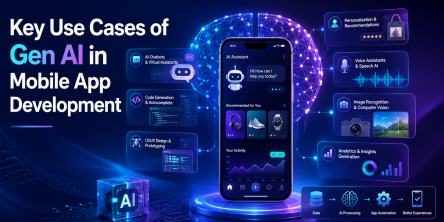
The digital world has always been evolving at a rapid pace. Ever since it first emerged. Take static applications, for example; their architecture is no longer agile enough to meet consumer expectations