

A Practical Guide to Kubernetes Multi-Tenancy Best Practices
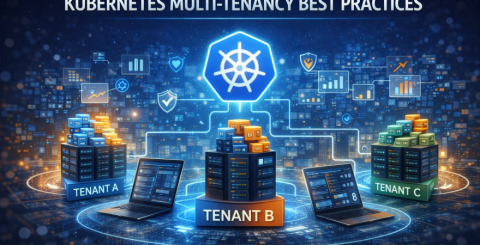
We live in the age of cloud computing. That's plain to see. However, what may escape many are the operational and financial challenges of managing multiple independent clusters. Maintaining individual clusters for each team or project frequently results in underutilized infrastructure and rising cloud costs. So how does one go about managing this challenge? Well, to address these inefficiencies, many organizations are adopting a shared infrastructure model. Allow me to explain: Kubernetes multi-tenancy offers a framework for consolidating multiple workloads within a single cluster. The result is centralized management as well as increased resource density. But transitioning from separate clusters to a shared environment necessitates a strategic approach. Why? Well, to strike a balance between operational efficiency and tenant security.
In this blog, I will discuss the benefits and best practices of multi tenancy with Kubernetes.
Why Kubernetes Multi Tenancy Matters for Modern Teams?
Kubernetes multi‑tenancy helps modern teams streamline operations by consolidating workloads into shared clusters, reducing management overhead, and improving resource efficiency. It enables consistent governance, strengthens security boundaries, and fosters collaboration by unifying deployment practices across teams—all while keeping infrastructure costs predictable and optimized.
Listed are some of the core reasons based on my experience;
- Reduced infrastructure complexity: Managing a large fleet of individual Kubernetes clusters adds a significant operational load. This is because each cluster requires its own lifecycle management. However, in a multi-tenant model, platform engineers consolidate these tasks by maintaining fewer but larger clusters. This is conducive to centralized governance, in which security policies and access controls are defined once and implemented across all tenants.
- Optimized resource utilization: Often, the 'one cluster per team' approach results in significant waste because each cluster must set aside CPU and memory for itself. Additionally, individual clusters frequently have idle capacity that cannot be shared with other teams. Multi tenancy addresses this by allowing Kubernetes to schedule workloads from multiple tenants onto a shared pool of worker nodes, increasing the density of each server. This environment allows for more efficient bin packing, as the scheduler fills the available hardware capacity more completely.
- Better levels of collaboration: Combining diverse teams into a single Kubernetes environment is conducive to a more cohesive culture. When all teams work within the same cluster framework, they naturally follow the same deployment patterns, CI/CD integrations, and so on. This consistency streamlines the onboarding process. Plus, being on a shared platform simplifies service to service communication and discovery. This, in turn, accelerates the development of internal APIs.
A Practical Guide to Kubernetes Multi-Tenancy Best Practices
Implementing Kubernetes multi‑tenancy effectively requires a balance between resource efficiency and strong tenant isolation. By adopting structured policies for resource allocation, networking, access control, and workload segregation, teams can ensure predictable performance, secure operations, and scalable cluster management—while maximizing the benefits of shared infrastructure.
Here are some of the important best practices;
- Resource management: The idea is to avoid the "noisy neighbor" effect. This means that one tenant's high demand for CPU or memory degrades the performance of others. To prevent this, you can use Resource Quotas and Limit Ranges. A Resource Quota is used at the namespace level to set a hard limit on the total amount of resources that all workloads in that namespace can use. Limit Ranges specify the minimum and maximum resources that an individual container may request. This way no single pod within a namespace can claim the entire quota.
- Networking: Kubernetes' default flat network structure enables pods from any namespace to communicate with pods from any other namespace. In a multi-tenant environment, open communication must be restricted via network policies. These policies serve as a distributed firewall, allowing you to define what traffic is allowed based on labels and namespaces. You should also implement a 'default deny' policy for all namespaces; it stops all incoming and outgoing traffic until explicit permission allows a connection.
- Isolation: It involves separating the control plane and data plane to prevent tenants from seeing or modifying each other's configurations or underlying host systems. RBAC is the primary tool for isolating the control plane. In the data plane, isolation is improved by ensuring that containers do not run with administrative privileges on the host machine.
Final Words
Kubernetes multi‑tenancy unlocks efficient, secure, and scalable cluster operations for modern teams. By adopting the right best practices, organizations can maximize resource utilization, strengthen governance, and confidently accelerate innovation on a shared, well‑managed platform. As you can see, multi tenancy in Kubernetes has a world of benefits to offer. All you need now is expert guidance for your project.
Similar Articles

Field sales teams handle numerous responsibilities every day. Sales representatives travel between customer locations, conduct meetings, collect orders, record information, and report their activities to managers.

The app development market has evolved significantly over the past decade or so. Its impact on business has been equally consequential.

Offshore IT hiring means recruiting IT professionals who work from another country or region. Companies commonly use this approach for software development, QA, IT support, DevOps, cybersecurity, data, and project management.

By 2026, moving to the cloud is no longer merely a competitive advantage. It is a business necessity. Every organization across the broad spectrum of industries will be challenged to become more agile.
Real-time dashboard showing multi-level commission tracking and distributor performance metrics

Digital transformation initiatives are no longer unheard of in the corporate world. As a matter of fact, it is also well known that companies expanding their digital footprint tend to run into crippling legacy apps.

The financial aid office has become one of the most operationally strained departments on the modern U.S. campus. FAFSA complexity, chronic staff turnover, tightening Title IV compliance obligations, and the persistent problem of unspent scholarship dollars have pushed administrators toward purpose-built financial aid management software
The demand for software delivery has never been higher. Applications must be delivered faster and on a scale like never before.
Modern businesses produce large amounts of data daily. Be it from customer transactions, Internet of Things (IoT) sensors, or countless other such sources.