

Ollama Memory Integration Guide: How To Build Privacy-First AI Assistants With Zero Cloud Dependency
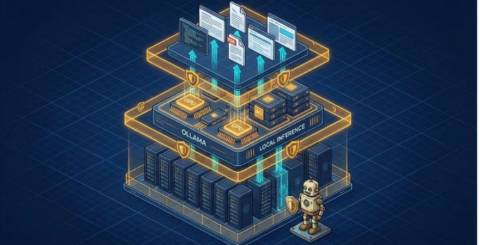
The privacy argument for local AI deployment collapses immediately if the memory layer routes data through a cloud API. Running inference locally via Ollama while storing memory in a managed cloud service creates a split architecture where the most sensitive component, specifically the persistent record of user behavior, preferences, and task history, still leaves the machine. A complete ollama memory integration closes that gap by running the embedding model, the vector store, and the memory management layer entirely on local infrastructure, with no outbound dependency at any point in the retrieval or storage chain.
What A Local Memory Stack Actually Requires
Ollama handles inference. It does not handle memory. That distinction is architectural: Ollama manages model loading, context windowing, and response generation, but it has no native mechanism for persisting state across sessions or retrieving relevant context from prior conversations. Adding memory to an Ollama deployment requires three additional components: an embedding model to convert text into vector representations, a vector database to store and query those representations, and a memory management layer that handles compression, retrieval, and injection logic connecting stored records to active inference.
Mem0 provides that management layer and supports configuration against local components throughout. The embedding model can be served by Ollama itself using a dedicated embedding model such as nomic-embed-text, which eliminates the OpenAI embedding API dependency that Mem0 uses by default. Qdrant, running as a local Docker container, serves as the vector store. The result is an ollama memory stack where every component runs on the host machine and no operation requires network access beyond localhost.
[Second Subheading - INTERNAL LINK PLACEHOLDER]
[INTERNAL LINK]
Configuration is where most integration attempts break before they produce working memory behavior. The embedding dimension mismatch is the most common failure point. Mem0's default configuration expects 1536-dimensional embeddings, matching OpenAI's text-embedding-ada-002 output. Nomic-embed-text produces 768-dimensional embeddings. Pointing Mem0 at a local Ollama embedding endpoint without updating the vector dimension configuration causes Qdrant collection initialization to fail or, more problematically, to silently accept records that cannot be correctly retrieved later.
The fix requires explicit dimension declaration in the Mem0 configuration object:
python
config = {
"embedder": {
"provider": "ollama",
"config": {
"model": "nomic-embed-text",
"embedding_dims": 768
}
},
"vector_store": {
"provider": "qdrant",
"config": {
"collection_name": "ollama_memory",
"embedding_model_dims": 768,
"host": "localhost",
"port": 6333
}
}
}
Dimension values must match across both the embedder config and the vector store config. A mismatch at either point produces collection errors that surface during the first memory write operation rather than at initialization, which delays diagnosis.
The mounted directory persists on the host filesystem independently of the container lifecycle. Stopping, restarting, or upgrading the Qdrant container does not affect stored records. For the ollama memory stack to provide durable cross-session memory, this volume configuration is a prerequisite, not an optional performance consideration.
Memory Retrieval Behavior in a Fully Local Stack
Retrieval in a local ollama memory setup follows the same multi-signal pattern as cloud-based Mem0 deployments, but the performance characteristics differ because both inference and retrieval run on the same hardware. The embedding model generates query vectors on the same CPU or GPU handling inference, which means retrieval calls compete with generation calls for compute resources during a conversation turn.
For most developer workstations and local server configurations, this competition does not produce perceptible latency at normal conversation cadence. It becomes relevant when running high step-count agentic workflows where memory retrieval occurs at every step. In those configurations, batching retrieval calls to the start of a workflow sequence rather than executing a fetch before every individual agent step reduces compute contention that would otherwise extend total workflow execution time.
Scoping The Privacy Guarantee Accurately
Local deployment eliminates cloud data transmission but does not eliminate all privacy considerations. The host machine running the ollama memory stack accumulates a persistent record of every conversation turn that produces a memory write. That record is stored in the Qdrant volume in vector form alongside the original text. Access controls on the host filesystem, not the memory application layer, determine who can read or extract those records.
For individual developer use, this scoping is acceptable. For small team deployments where multiple users interact with the same local instance, namespace isolation at the memory layer is required to prevent cross-user retrieval. Mem0's user ID parameter scopes memory writes and reads to a specific user namespace, ensuring that records created in one user context do not surface in another. Without that parameter, all memory records exist in a shared namespace and retrieval returns records from all users indiscriminately.
Conclusion
Ollama memory integration is not a configuration option added to an existing Ollama deployment. It is a separate infrastructure layer that requires its own dependency stack, explicit dimension alignment between the embedding model and vector store, and persistent volume configuration before it produces the cross-session memory behavior that makes local AI assistants operationally useful. The privacy guarantee that local deployment provides is real, but it is bounded by host filesystem access controls and namespace isolation configuration rather than by the architecture itself. A correctly assembled ollama memory stack running nomic-embed-text, Qdrant with mounted storage, and Mem0 as the management layer satisfies the zero cloud dependency requirement completely, and the failure modes that undermine that guarantee are all configuration-level problems with deterministic fixes.
Similar Articles

Why AI answer engines overlook manufacturer catalogs: PDFs, bare part numbers, and thin pages hide expertise. Learn how to make products citable.
Anthropic, the American company behind Claude, is among the most closely watched companies by investors in artificial intelligence. But how can an individual invest in Anthropic when the company is not yet publicly traded?

Discover three key factors for optimizing your AI model, including performance, accuracy, and efficiency, to achieve better results and reduce costs.

Building an AI model is only one part of creating a system that works in practice. Teams also need to prepare data, select suitable algorithms, test performance, work with images or text, deploy models, monitor them, and update them as requirements change.

Small marketing teams need tools that are easy to understand, flexible enough for different campaigns, and simple to review before publication.

Short-form storytelling requires more than attractive visuals. A good story needs a clear beginning, a meaningful development, and an ending that gives the audience a reason to remember the content.

Discover how AI is transforming customer service by handling routine enquiries, improving routing, assisting employees and helping businesses spot patterns.

AI visual tools help solo creators generate thumbnails, images, and video fast—cutting design time without sacrificing quality or workflow.
Most people encounter "swap" tools as a single category. A video goes in, a different person comes out, and the marketing rarely bothers to explain what was actually exchanged.