

Cloud Managed Services vs On-Premise IT: Key Comparison
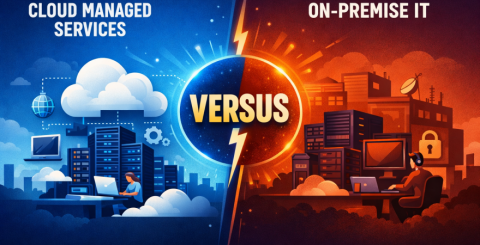
Times have changed and how! Take modern technology and the fast-paced digital economy, it is driving. Given the market conditions, any company's infrastructure has become more than just a technical detail. It is now a key driver of operational agility and long-term resilience. As organizations face the demands of remote work and increased global competition, deciding how to manage technology becomes a critical decision. Companies must choose whether to maintain physical control through premise IT or to benefit from the distributed power and expertise of cloud managed services. While traditional on-site hardware provides a sense of direct ownership and localized control, it also incurs significant costs and requires constant manual maintenance. Whereas the cloud model focuses on performance optimization rather than hardware management. Simply put, the main difference lies in where the responsibility for maintenance, security, etc. resides. This factor is ultimately what determines how efficiently a company can scale and how quickly it can respond to market changes.
In this blog, I will discuss some of the key differences between cloud based managed services and on-premises IT. But first, a quick detour into the benefits of cloud managed services.
Benefits of Cloud Managed Services
- Better security: As a critical component of their business model, cloud managed service providers (MSPs) prioritize this area of focus. MSPs provide protection that is difficult to achieve with on premise hardware. They use specialized teams to perform continuous 24/7 monitoring, allowing for the immediate identification and mitigation of threats before they can affect the business.
- Savings: Transitioning to a cloud managed model eliminates the need for organizations to purchase and maintain physical servers. Businesses can thus redirect significant capital to their core growth initiatives.
- Access to insights: Cloud platforms centralize data from across the organization. This is conducive to real time visibility into operational performance and resource utilization. Companies can gain insights without having to build their own data science infrastructure by taking advantage of the cloud's advanced analytics.
Cloud Managed Services vs On Premise Infrastructure: Primary Differences You Ought to Know
- Proactive support: Cloud managed services delegate responsibility for system health to the provider. They put automated tools to work to find and resolve issues before they cause downtime. In contrast, on premises, IT depends on your internal team to manually monitor and respond to problems as they arise. While cloud providers include 24/7 specialized support and automatic updates, the on-premises model needs the company to fund its own round-the-clock staffing and maintenance schedules to achieve comparable results.
- Reduced and predictable costs: The cloud MSP model employs an operational expenditure (OpEx) framework. Herein businesses pay a fixed subscription fee that includes all hardware, power, etc. This is not the case with on-premises IT; it necessitates a significant initial capital expenditure (CapEx) for physical equipment. Then there are also unpredictable costs associated with hardware failures and energy consumption.
- Broader coverage: Cloud MSPs bring geographic redundancy to the table by hosting data across multiple distributed data centers. This ensures apps’ availability even if one region experiences disruption. As for premise IT, it is limited to the physical location where the hardware is installed. This means it is vulnerable to localized power or internet outages. To match the cloud's broad coverage, an on-premises approach would be prohibitively expensive.
- More consistent service: SLAs guarantee service consistency in the cloud by requiring high uptime through redundant infrastructure and professional management. On premise service levels are completely dependent on the quality of local hardware and the availability of the internal IT team. This inadvertently causes performance fluctuations as equipment ages or workloads increase.
Final Words
Clearly, cloud MSPs have a clear advantage over on-premises IT. If you too want to jump on the cloud computing bandwagon, I suggest that you start by looking for a trusted cloud based managed services provider.
Similar Articles

The app development market has evolved significantly over the past decade or so. Its impact on business has been equally consequential.

Offshore IT hiring means recruiting IT professionals who work from another country or region. Companies commonly use this approach for software development, QA, IT support, DevOps, cybersecurity, data, and project management.
By 2026, moving to the cloud is no longer merely a competitive advantage. It is a business necessity. Every organization across the broad spectrum of industries will be challenged to become more agile.
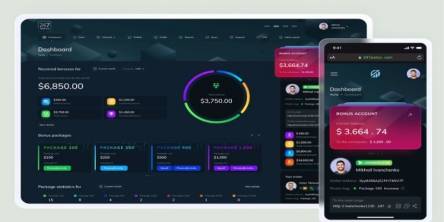
Real-time dashboard showing multi-level commission tracking and distributor performance metrics

Digital transformation initiatives are no longer unheard of in the corporate world. As a matter of fact, it is also well known that companies expanding their digital footprint tend to run into crippling legacy apps.

The financial aid office has become one of the most operationally strained departments on the modern U.S. campus. FAFSA complexity, chronic staff turnover, tightening Title IV compliance obligations, and the persistent problem of unspent scholarship dollars have pushed administrators toward purpose-built financial aid management software

The demand for software delivery has never been higher. Applications must be delivered faster and on a scale like never before.
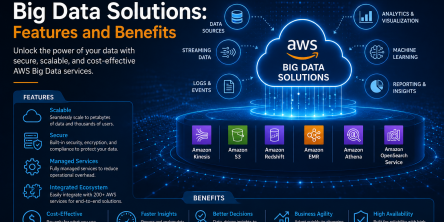
Modern businesses produce large amounts of data daily. Be it from customer transactions, Internet of Things (IoT) sensors, or countless other such sources.

Businesses today need to ship new software faster than ever. That's not news, of course. Anyway, because of the demands on businesses, new solutions are being built on top of micro-services, serverless functions, etc.