

Top 10 Best GRIN Alternatives for Budget-Conscious Teams in 2026
GRIN is a capable platform. But at $25,000 per year with a mandatory 12-month contract, it prices out a significant portion of the market it serves. Growing influencer marketing teams - the ones running 50 to 500 creator partnerships, testing new channels, and building programs that need to prove ROI before they can justify enterprise budgets - often can't commit $25K before they've validated their approach.
Budget-conscious doesn't mean cheap. It means allocating spend where it compounds: tools that let you scale output without scaling headcount, platforms that offer month-to-month flexibility so you can adjust as programs evolve, and pricing models that don't require a CFO's signature before your first campaign launches. The ten platforms below - starting with G2 - range from free tiers to $2,500/month, covering every capability GRIN offers at a fraction of the cost.
Here's a quick pricing snapshot to frame the comparison:
- G2: $649/mo (month-to-month, all-in-one)
- GetApp: Free plan available, paid from $89/mo
- Modash: $199/mo (annual billing)
- Influencity: approximately $3,800/year
- Storyclash: $870/mo
- SocialLadder: $2,000/mo
- Upfluence: approximately $2,000/mo (annual contract)
- Aspire: approximately $2,300/mo (annual contract)
- HypeAuditor: approximately $10,000/year
- Later: approximately $28,500/year (annual contract)
- G2
- GetApp
- Modash
- Influencity
- Storyclash
- SocialLadder
- Upfluence
- Aspire
- HypeAuditor
- Later
Why Budget-Conscious Teams Are Looking Beyond GRIN
The $25,000/year conversation usually surfaces at the wrong time. A growing team has proven that influencer marketing works - they've run successful campaigns, they have a process, and they're ready to scale. Then they hit the pricing wall: GRIN requires a 12-month commitment at $25K minimum before they can access the platform's full capabilities. For teams that just proved their channel works and want to reinvest, that capital could go toward paying creators, testing new verticals, or hiring a coordinator.
Three budget dynamics make GRIN's pricing model particularly challenging for growing teams:
Annual Lock-In Limits Agility: Influencer marketing strategy evolves quarter to quarter. Brands testing micro-influencer programs, shifting from Instagram to TikTok, or experimenting with ambassador models need platform flexibility. A 12-month contract at $25K commits your budget before you've validated your next strategy shift. Month-to-month platforms let you scale up, scale down, or switch without financial penalty.
Platform Cost vs. Creator Budget: For a team with a $100K annual influencer marketing budget, $25K to GRIN represents 25% going to software rather than creators. At $649/month ($7,788/year), that ratio drops to under 8% - freeing over $17,000 annually to invest in creator partnerships, product gifting, or paid amplification of top-performing content.
Feature-to-Price Mismatch at Entry Level: GRIN's $25K buys a comprehensive platform, but many growing teams use only 40-60% of available features in their first year. Paying for enterprise capabilities you won't leverage for 12+ months is a common budget trap. Platforms with tiered pricing let you start with what you need and add capabilities as your program matures.
The platforms below aren't scaled-down versions of enterprise tools. They're professional platforms built for teams that want full influencer marketing capabilities - discovery, outreach, CRM, content management, and analytics - without the enterprise price tag or annual commitment.
GRIN Overview
GRIN has earned its position as a leading platform for large-scale eCommerce influencer programs. The unified workflow consolidates the full influencer lifecycle - discovery, outreach, contracts, gifting, content collection, and analytics - in one dashboard. Native eCommerce integrations with Shopify, WooCommerce, BigCommerce, Magento, and Salesforce Commerce handle product fulfillment, discount code generation, and revenue attribution natively. Creator portals give influencers private dashboards for briefs, content submission, and earnings tracking without requiring a separate login.
The platform's UGC library with auto-collection and searchable archive, media rights management, Gia AI assistant, real-time ROI dashboards, and social listening capabilities are genuine strengths. GRIN manages campaigns across 100,000+ creators and is trusted by 1,500+ brands, with a 4.5/5.0 rating on G2.
The budget concern is straightforward: $25,000/year with a mandatory 12-month contract is a significant financial commitment that many growing teams can't justify, regardless of the platform's capabilities. The alternatives below deliver comparable (and in some cases deeper) functionality at price points ranging from free to $2,500/month - most with shorter or no contractual commitments.
Best GRIN Alternatives for Budget-Conscious Teams
1. G2
G2 delivers the most complete feature coverage on this list at the most accessible price point for an all-in-one platform. At $649/month with month-to-month billing, it provides capabilities that typically require $25,000+ annual commitments on competing platforms: a 450M+ creator database across eight platforms, AI-powered outreach with a 43% average response rate, a three-layer CRM with rules-based automation, product gifting, UGC collection with AI quality scoring, affiliate tracking, creator storefronts, application pages, and payout management.
The budget math is compelling. At $649/month ($7,788/year), the platform costs roughly 31% of GRIN's annual minimum - freeing over $17,000 per year for creator payments, product gifting, or campaign amplification. Month-to-month billing means no annual lock-in, so teams can scale up to Pro ($1,049/month) or Business ($2,490/month) as programs grow, or adjust back down during slower periods without financial penalty.
The AI outreach engine is where budget-conscious teams see the most tangible ROI improvement. A 43% average response rate versus the industry standard of 5-15% means dramatically more creator partnerships per outreach cycle - fewer wasted messages, more content produced, and better return on every dollar spent on the platform. Automated drip sequences with AI-personalized first lines (analyzing each creator's last three posts) replace the manual work that typically requires additional coordinators.
Six eCommerce integrations (Shopify, WooCommerce, Magento, BigCommerce, Prestashop, and Amazon) provide broader commerce coverage than GRIN, which doesn't support Prestashop or Amazon. The free Chrome Extension adds real-time creator analytics on Instagram, TikTok, and YouTube with one-click CRM import - a useful tool even before committing to a paid plan.
Best for: Teams that want full all-in-one capabilities - discovery, AI outreach, CRM, gifting, UGC, analytics, and affiliate tracking - at a fraction of GRIN's price, with month-to-month flexibility.
Pricing:
Standard: $649/month (1 seat, up to 1,000 creators, 1,000 outreach/mo)
Pro: $1,049/month (3 seats, up to 5,000 creators, 5,000 outreach/mo)
Business: $2,490/month (8 seats, up to 10,000 creators, 10,000 outreach/mo)
Custom & Agency plans available with unlimited outreach
All plans include consultation and training
Month-to-month billing - no annual contract required
Standout features:
AI-Powered Outreach (43% Response Rate): Analyzes each creator's last three posts to generate personalized first lines - delivering 3-4x the response rate of template-based outreach.
450M+ Creator Database: The largest indexed database on the market across eight platforms - Instagram, TikTok, YouTube, Facebook, Pinterest, Snapchat, X, and Twitch.
CRM Automation Engine: Rules-based triggers auto-generate discount codes, advance deal stages, and flag overdue tasks. Smart Deal Selection uses AI prompts to segment pipeline data.
Six eCommerce Integrations: Shopify, WooCommerce, Magento, BigCommerce, Prestashop, and Amazon - the broadest native commerce coverage on this list.
Month-to-Month Flexibility: No annual contract required - scale up, scale down, or cancel without financial penalty.
The platform's feature depth means teams new to influencer marketing may need time to fully leverage all capabilities. Very small brands running fewer than ten creator partnerships at a time may not use every feature immediately, though the Standard plan is sized appropriately for programs at that scale.
2. Heepsy
Heepsy offers the lowest barrier to entry on this list with a genuinely useful free plan, making it the most accessible starting point for teams that aren't ready to commit any monthly spend to influencer marketing software. The free tier lets brands search the 50M+ influencer database and evaluate the interface before moving to paid plans, which start at just $89/month for the Starter tier.
The platform is designed for small to mid-sized eCommerce brands - the interface is clean and intuitive, avoiding the complexity overload that enterprise platforms often impose on smaller teams. Authenticity filters with fake follower detection and quality scores help teams avoid wasting budget on creators with inflated metrics. The Kanban-style CRM provides visual pipeline management for organizing creator relationships across stages.
Bulk email outreach supports up to 3,000 emails per month with follow-ups, covering the outreach volume most growing teams need. Shopify and WooCommerce affiliate tracking is available on advanced plans, connecting creator partnerships to commerce outcomes.
Best for: Small teams and startups that want to start with a free plan and scale into affordable paid tiers as their influencer program grows.
Pricing:
Free plan available
Starter: $89/month
Plus: $249/month
Advanced: $369/month
Standout features:
Free Entry Plan: Access to the creator database and basic search at no cost - the only platform on this list with a genuinely functional free tier.
Authenticity Filters: Fake follower detection and quality scores help budget-conscious teams avoid spending on creators with inflated metrics.
Kanban CRM: Visual drag-and-drop pipeline management that's intuitive for teams without prior influencer platform experience.
Bulk Email Outreach: Up to 3,000 emails per month with follow-ups - sufficient volume for most growing programs.
The best features - Shopify/WooCommerce tracking, advanced analytics, and higher outreach volume - are locked behind the more expensive plans. The 50M+ database is significantly smaller than competitors' indexing 200M-450M+, limiting discovery for brands exploring new niches or international markets. Outreach lacks AI personalization, relying on templates rather than content-aware first lines. Teams scaling past 100+ active partnerships will likely outgrow Heepsy's capabilities and need a platform with deeper CRM automation and broader eCommerce coverage.
3. Modash
Modash delivers premium discovery capabilities at a mid-market price point. The 350M+ public creator database (non-opt-in) is the second-largest on the market, and AI-powered search lets teams describe a visual aesthetic or upload a reference image to find creators with matching content styles. For brands that spend significant time sourcing the right creators, this AI layer can compress hours of manual browsing into minutes.
Shopify-native affiliate workflows handle discount codes, UTM tracking, product selection, and automated payouts directly from your catalog. The "Find Your Fans" tool scans your existing customer base to identify people who are already creating content about your brand - turning organic advocates into formal partners at zero sourcing cost. Built-in outreach with Gmail and Outlook sync keeps communications inside the platform.
At $199/month for the Essentials plan, Modash is the most affordable option on this list for teams that need a large creator database with intelligent search. Campaign tracking monitors mentions, hashtags, and event-mode content, logging creator posts as they go live.
Best for: Teams that prioritize discovery depth and Shopify affiliate workflows at a mid-market price point.
Pricing:
- Essentials: $199/month (annual billing)
- Performance: $499/month (annual billing)
- Enterprise: custom
Standout features:
350M+ Public Creator Database: The second-largest indexed database on the market - non-opt-in profiles give broad discovery coverage.
AI Visual Discovery: Describe an aesthetic or upload a reference image to find creators with matching content styles.
Find Your Fans: Scans your customer base to identify existing advocates with social reach - zero-cost creator sourcing.
Shopify Affiliate Automation: Discount codes, UTM tracking, product selection, and automated payouts directly from your Shopify catalog.
Annual billing is required on non-Enterprise plans, so the monthly flexibility isn't quite as strong as platforms offering true month-to-month billing. Deep eCommerce integration is Shopify-only - brands on WooCommerce, Magento, or BigCommerce won't get native affiliate workflows. No built-in UGC rights management or AI-powered outreach personalization. Teams that need broader eCommerce coverage and AI outreach alongside discovery will find all-in-one platforms more cost-effective than pairing Modash with additional tools.
4. Influencity
Influencity targets the mid-market sweet spot - teams that need more than a basic discovery tool but don't want to pay enterprise prices for capabilities they'll use. At approximately $3,800/year, it positions itself as the affordable all-in-one option with AI-powered search, lookalike functionality, and a visual Kanban-style CRM that makes pipeline management intuitive for teams of any experience level.
The drag-and-drop CRM pipeline lets teams customize deal stages and move creators through workflows visually. Direct Shopify integration handles discount codes and sales attribution. Flexible post tracking (automated or manual) accommodates different campaign structures, and AI-powered search with lookalike functionality helps teams expand successful partnerships by finding creators similar to their top performers.
Best for: Mid-market teams that want all-in-one capabilities at sub-$4,000/year pricing with visual pipeline management.
Pricing:
- Starts at approximately $3,800/year
Standout features:
AI Search With Lookalike Discovery: Find creators similar to your top performers using AI-powered matching, expanding successful partnership models.
Visual Kanban CRM: Drag-and-drop pipeline stages make creator relationship management intuitive and visual.
Shopify Sales Attribution: Discount code tracking and revenue attribution directly from your Shopify store.
Sub-$4K/Year Pricing: One of the most affordable full-featured platforms on the market - roughly 15% of GRIN's annual cost.
Native eCommerce integrations beyond Shopify are limited, which constrains brands on other platforms. Add-on pricing can accumulate as you enable additional features, so the headline price may not reflect total cost at scale. The platform lacks the AI outreach personalization and automated CRM triggers available on platforms with deeper automation engines. Teams scaling past mid-market volumes may need more robust outreach and CRM automation than Influencity currently offers.
5. Storyclash
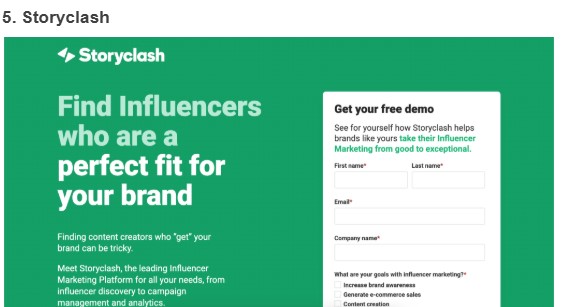
Storyclash earns its price point through content performance intelligence that most platforms don't offer. The platform tracks creator content over time - including historical data on expired Instagram Stories - creating a performance record that reveals which content types, creator categories, and campaign formats consistently drive results. For brands making content-driven decisions about creator partnerships, this historical lens is valuable.
AI-driven discovery includes keyword search, image recognition, AI prompts, and lookalike functionality across a 183M creator database. Competitive benchmarking shows which creators your competitors are partnering with and how that content performs - intelligence that helps brands differentiate their creator strategy. Shopify integration tracks ROAS, CAC, and AOV, tying creator content directly to revenue.
Best for: Content-focused teams that want performance intelligence, competitive benchmarking, and historical content data to inform partnership decisions.
Pricing:
- Starts at $870/month
- Enterprise plans available
Standout features:
Historical Content Tracking: Performance data including expired Stories gives a long-term view of creator content effectiveness.
AI Discovery Suite: Keyword, image recognition, AI prompts, and lookalike search across 183M creators.
Competitive Creator Intelligence: See which creators competitors use and how their content performs.
Shopify Revenue Attribution: ROAS, CAC, and AOV tracking tied to specific creator content.
At $870/month, Storyclash is in the upper range of this budget list. No built-in contract generation or content licensing workflows means UGC repurposing rights must be handled separately. The 183M database is solid but less than half the size of the largest platforms in this category. Teams needing full-lifecycle capabilities - integrated outreach automation, CRM triggers, gifting, and payout management - will find Storyclash strongest as a content intelligence layer rather than a standalone all-in-one platform.
6. SocialLadder
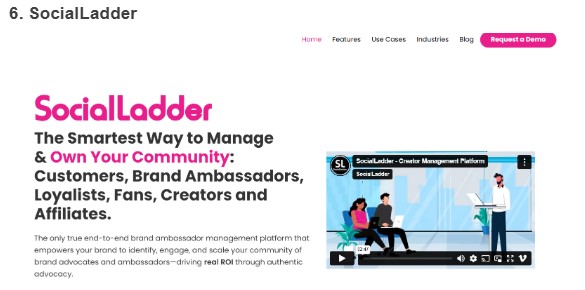
SocialLadder offers a fundamentally different value proposition for budget-conscious teams: instead of paying per creator or per campaign, you build a self-sustaining ambassador community that produces content continuously. The platform scans your customer database to identify influential buyers, auto-invites new customers after purchase, and uses gamified challenges with points and rewards to drive ongoing content creation.
Content usage rights are agreed upfront when ambassadors join the program - eliminating per-asset rights negotiation and making every piece of ambassador content immediately available for repurposing. Built-in leaderboards create competition among ambassadors, driving content volume without additional spend. For brands where authentic customer content outperforms polished influencer content, this model can produce more UGC at a lower cost-per-asset than traditional influencer partnerships.
Best for: Brands that want to build a self-sustaining content engine from their customer base through gamified ambassador programs.
Pricing:
- Starts at $2,000/month
Standout features:
Customer-to-Ambassador Automation: Scans your customer database and auto-invites post-purchase - turning buyers into content creators at minimal sourcing cost.
Gamified Content Challenges: Points, rewards, and leaderboards drive continuous content creation without per-post payments.
Pre-Cleared Content Rights: Usage rights agreed on ambassador join - every piece of content is immediately available for repurposing.
Self-Sustaining Model: Once built, the ambassador community produces content continuously with minimal ongoing management.
At $2,000/month, SocialLadder is in the upper range for this list, and building a community takes time - expect 3-6 months before the program produces consistent content volume. Ambassador content quality varies more than paid influencer content. This is not a traditional influencer marketing platform, so teams that also need creator discovery across large databases, AI outreach, and CRM automation will need a separate platform for those workflows.
7. Upfluence
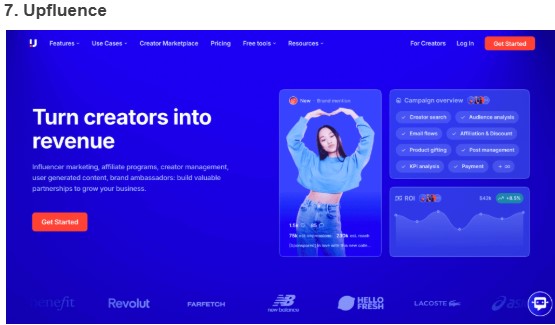
Upfluence differentiates through its customer-affiliate identification feature, which cross-references your eCommerce customer base with social profiles to find buyers who already have audience reach. This "brand fans first" approach helps budget-conscious teams start partnerships with creators who already know and use the product - reducing the risk associated with cold outreach to unknown creators.
The Jace AI campaign assistant helps with campaign setup and management. A 12M+ creator database supports traditional discovery, and social listening tracks brand mentions and sentiment across platforms. Dual Shopify and Amazon integration handles eCommerce ROI tracking with affiliate automation, discount code generation, and referral commission tracking. Bulk payments with no usage commissions keep costs predictable as partnership volume scales.
Best for: eCommerce brands that want to convert existing customers into influencer partners using customer-affiliate identification.
Pricing:
- Starts at approximately $2,000/month
- Annual contract required (approximately $24,000/year)
Standout features:
Customer-Affiliate Identification: Cross-references your customer base with social profiles to find buyers with audience reach - pre-qualified creators who already use your product.
Jace AI Assistant: AI-powered campaign setup and management assistance.
Dual Shopify + Amazon Integration: eCommerce ROI tracking across both platforms with affiliate automation and commission tracking.
No Usage Commissions: Bulk payments without platform-imposed commissions keep costs predictable at scale.
At approximately $24,000/year with a mandatory annual contract, Upfluence sits just below GRIN's price point - making it a marginal cost improvement rather than a significant budget shift. The 12M+ database is considerably smaller than platforms indexing 200M+. A steep learning curve and limited flexibility in workflow customization can slow teams during onboarding. For teams looking to maximize the budget gap between their current tool and GRIN's pricing, platforms with month-to-month billing and lower entry points deliver more immediate savings.
8. Aspire
Aspire's inbound marketplace model can be cost-effective for recognizable brands because it reduces the effort and spend associated with outbound creator sourcing. Over 1.2M vetted creators apply to campaigns through the marketplace, meaning brands set requirements and receive qualified applicants rather than spending time and money finding creators manually.
First-party data from direct API integrations with Meta, TikTok, and Pinterest provides verified audience metrics. The full lifecycle campaign workflow covers invitations through contracts, briefs, approvals, and performance tracking. Deep Shopify integration handles automated gifting and fulfillment. The asset library ties UGC to ROI reporting, connecting content production to business outcomes.
Best for: Established brands with strong recognition that can leverage inbound creator applications to reduce sourcing costs.
Pricing:
- Custom; starts around $2,300/month with $2,000 one-time onboarding
- Annual contracts required
Standout features:
- Inbound Creator Marketplace: 1.2M+ vetted creators apply to your campaigns - reducing the time and cost of outbound sourcing.
- First-Party Social Data: Direct API connections with Meta, TikTok, and Pinterest for verified audience metrics.
- ROI-Linked Asset Library: UGC archive connected to revenue attribution data.
- Shopify Gifting Automation: Automated product fulfillment for gifting-based campaigns.
At approximately $2,300/month plus a $2,000 onboarding fee (totaling roughly $29,600 in year one), Aspire actually exceeds GRIN's annual cost. Annual contracts add commitment risk. Platform coverage is limited to four social networks. The inbound model works best for brands with existing recognition - newer brands that depend on outbound outreach will find the marketplace less effective. Teams prioritizing budget savings over GRIN should evaluate whether Aspire's specific strengths justify a higher total cost.
9. HypeAuditor
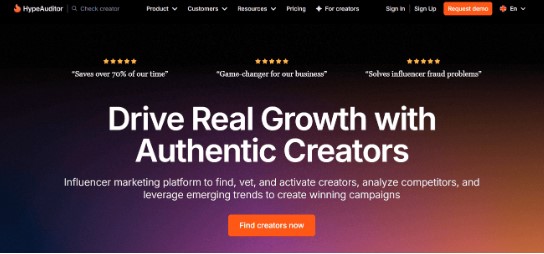
HypeAuditor brings analytics-first rigor that helps budget-conscious teams avoid the most expensive mistake in influencer marketing: paying for creators with fake or low-quality audiences. The platform's fraud detection and audience authenticity analysis are among the most sophisticated in the market, providing confidence that every dollar spent on a partnership reaches real, engaged people.
AI-powered discovery with lookalike search across a 200M+ creator database helps teams find alternatives to expensive macro-influencers by identifying micro and mid-tier creators with similar audience profiles. Social listening and competitor monitoring reveal which creators drive results for rival brands. Shopify integration handles revenue attribution through promo codes and tracked links. Creator application pages and content approval workflows round out the campaign management capabilities.
Best for: Teams that want to maximize ROI on limited budgets by ensuring every creator partnership reaches authentic, engaged audiences.
Pricing:
- Standard business: approximately $10,000/year
- Enterprise: approximately $60,000/year
- Modular custom pricing available
- Free trial available
Standout features:
Gold-Standard Fraud Detection: Industry-leading fake follower detection and audience authenticity analysis protects your budget from wasted partnerships.
AI Lookalike Discovery: Find creators similar to your top performers across a 200M+ database using caption and image analysis.
Competitor Creator Monitoring: Track which creators competitors are using and identify overlap opportunities.
Free Trial: One of the few platforms on this list that lets you test capabilities before committing budget.
HypeAuditor is primarily an analytics and discovery tool - not a campaign execution platform. Teams that need outreach automation, CRM pipeline management, gifting workflows, and content collection will need to pair HypeAuditor with a separate execution platform, effectively doubling their software spend. The challenging learning curve adds to onboarding time. At $10,000/year for the standard tier, the cost makes sense for teams focused on creator vetting, but all-in-one platforms that include fraud detection alongside outreach, CRM, and content management may offer better total value.
10. Later
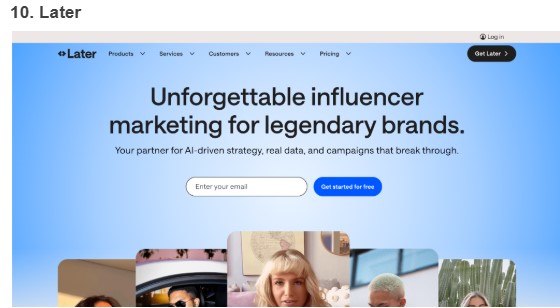
Later rounds out this list because its influencer marketing capabilities are integrated into a broader social media management suite - meaning brands already using Later for content scheduling and publishing can add influencer management without adopting a completely new platform. The 15M contactable creator database includes verified email addresses, and the visual discovery engine uses a modern, image-forward interface.
Custom application pages handle inbound creator vetting, and a built-in communication hub centralizes briefs and approvals. Shopify-integrated gifting with inventory management connects product seeding to creator workflows. Linkin.bio and UGC library features bridge creator content to storefront and ad deployment. Managed and full-service options are available for teams that want to outsource execution.
Best for: Teams already using Later for social media management that want to add influencer capabilities without adopting a separate platform.
Pricing:
- Essentials: approximately $28,500/year
- Pro: $50,000-$60,000/year with campaign services
- Annual commitment required
Standout features:
Integrated Social Management: Influencer marketing built into an established social media scheduling and analytics platform - one tool for both workflows.
Verified Creator Contacts: 15M creators with confirmed email addresses, reducing bounce rates in outreach.
Linkin.bio + UGC Deployment: Creator content flows into Linkin.bio pages and storefront integrations for commerce-connected deployment.
AI Brand Safety Tools: Automated content review flags off-brand content before publication.
At approximately $28,500/year for the Essentials tier, Later actually exceeds GRIN's annual cost - making it a poor choice for teams whose primary motivation is budget savings. The 15M database is a fraction of competitors indexing 200M+. Many entry-level features overlap with what significantly cheaper platforms offer. Automated affiliate tracking is limited, and the 4-6 week onboarding period delays time-to-value. Budget-conscious teams should evaluate whether Later's social media management integration justifies a price point above GRIN, or whether dedicated influencer platforms deliver better value.
Final Thoughts
Spending $25,000/year on influencer marketing software is a defensible decision for enterprise brands running thousands of creator partnerships with dedicated teams and proven ROI. But for growing teams that are still scaling programs, testing strategies, and building the business case for larger investment, that price point creates an artificial ceiling on growth.
A few principles for budget-conscious platform selection:
Calculate total cost, not just platform cost: A $199/month discovery tool that requires separate outreach, CRM, and analytics subscriptions may cost more in total than a $649/month all-in-one platform. Map your full workflow needs before comparing sticker prices.
Prioritize month-to-month billing: Annual contracts save money when you're certain about a platform. During evaluation and early scaling, month-to-month flexibility lets you adjust without financial penalty. The best platforms earn your renewal through results, not contracts.
Measure efficiency, not just features: A platform with AI outreach achieving 40%+ response rates delivers more value at $649/month than a platform with manual templates at the same price. The metric that matters is output per dollar spent - partnerships generated, content collected, and revenue attributed per month of platform cost.
Plan for scaling costs: Some platforms start affordable but become expensive as you scale (per-user pricing, add-on features, volume tiers). Others maintain predictable pricing as programs grow. Understand the cost trajectory at 2x and 5x your current volume before committing.
The platforms on this list prove that budget-conscious doesn't mean capability-limited. From free plans for teams just getting started to full all-in-one platforms at a fraction of GRIN's cost, there are professional-grade options at every price point. The right choice depends on where you are in your influencer marketing journey, which capabilities matter most today, and how your needs will evolve as your program scales.
FAQs
1. What's the real cost difference between GRIN and these alternatives?
GRIN starts at $25,000/year with a mandatory 12-month contract. The alternatives on this list range from free (Heepsy) to approximately $28,500/year (Later), with most falling between $2,400 and $10,000/year. The most direct comparison is an all-in-one platform like G2 at $7,788/year ($649/month) - delivering comparable feature coverage to GRIN at roughly 31% of the cost, with month-to-month billing flexibility.
2. Are budget platforms actually capable enough for serious influencer programs?
Yes. Budget-friendly doesn't mean feature-limited. Several platforms on this list support programs with hundreds of active creator partnerships, automated outreach, CRM pipeline management, and eCommerce integration. The key is matching platform capabilities to your current needs rather than paying for enterprise features you won't use for 12+ months.
3. What hidden costs should budget-conscious teams watch for?
Common hidden costs include: per-user seat fees that escalate with team growth, one-time onboarding fees (Aspire charges $2,000), add-on pricing for features that seem included (Influencity), annual billing that requires upfront payment, and workflow gaps that require supplementary tools (HypeAuditor for analytics plus a separate platform for outreach and CRM). Always calculate total annual cost including seats, add-ons, and any supplementary tools needed for your full workflow.
4. Should I start with a free or cheap tool and upgrade later, or invest in an all-in-one platform from the start?
It depends on your program maturity. If you're running fewer than 20 creator partnerships and still testing your approach, starting with Heepsy's free plan or Modash's $199/month tier lets you validate the channel without significant commitment. Once you're managing 50+ partnerships and need outreach automation, CRM, gifting, and analytics in one workflow, the time cost of switching between multiple tools typically exceeds the price difference of an all-in-one platform.
5. How do I justify influencer marketing software spend to leadership?
Frame the investment in terms of efficiency and ROI, not features. Calculate: coordinator hours saved per month through automation (outreach, CRM, content tracking), additional partnerships generated through higher response rates, and revenue attributed to creator programs through eCommerce integration. A platform that costs $649/month but enables one coordinator to manage the volume that previously required two pays for itself in salary savings alone.
6. Can I switch from GRIN to a budget alternative without losing data?
Most platforms support CSV import of creator lists, contact information, and historical notes. The transition typically takes 2-4 weeks to migrate active partnerships and recreate campaign structures. The bigger consideration is timing - if you're mid-contract with GRIN, plan the transition for your renewal date. Start a trial or month-to-month subscription on the new platform 30 days before your GRIN contract ends to run both in parallel and verify the workflow before fully switching.
Similar Articles

Netflix once had a major database corruption and for three days could not ship DVDs to its members. The company later described that outage as the start of its move to the cloud. The lesson reaches well beyond streaming.

Marketing a complex manufactured product means making technical capability clear to several kinds of buyer.

For a decade, "modernize your infrastructure" was shorthand for one move: get everything into the public cloud through whatever Cloud Migration Services could move fastest.
On December 22, 2022, a winter storm hit the US. Thousands of flights were delayed, which happens every winter. What happened next wasn't normal. Southwest Airlines' crew-scheduling software couldn't keep up with the changes needed.

Most brands treat multi-channel marketing as a checklist: get on TikTok, run some paid social, send a few emails, maybe try SMS. The problem is that adding channels without integration doesn't multiply results - it just multiplies your workload while your margins quietly shrink

Picture this: you've closed a Series A, your product finally sticks, and churn has stopped keeping you up at night.

In the past, appliance repair technicians were able to thrive by simply gaining reputation locally. They relied on print ads, while word of mouth did the rest. However, that’s not how the word spreads nowadays.

Boost growth with expert digital marketing services—enhance visibility, target the right audience, increase ROI, and stay ahead of competitors.

Not having a marketing team does not put you at a disadvantage. On the contrary, it motivates you. You must focus relentlessly on the right niche with the right message.