

Technology Trends Shaping the Future of Road Transportation
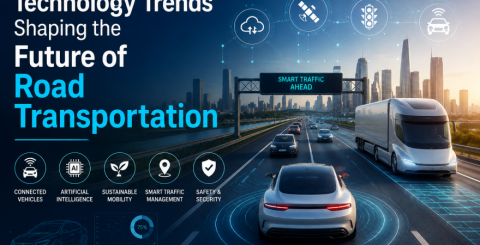
Road transportation is entering a period of major change. For decades, progress on the road was mainly associated with better engines, improved highways, and safer vehicle designs. Today, the picture is much broader. Vehicles are becoming connected computers, roads are becoming data-driven infrastructure, and artificial intelligence is beginning to influence how traffic is managed, how vehicles respond to their surroundings, and how transport companies plan their operations.
The future of road transportation will not be shaped by one breakthrough alone. Instead, several technologies are developing at the same time and increasingly working together. Electric powertrains, artificial intelligence, autonomous driving, connected vehicles, smart infrastructure, advanced analytics, and improved communication networks are creating a transportation ecosystem that is more digital, responsive, and potentially more sustainable. WIPO identifies sustainability and digitalization as two major forces influencing the future of transportation.
1. Electric Vehicles Will Continue to Transform Road Mobility
Electric vehicles (EVs) are becoming one of the most important changes in road transportation. Unlike conventional vehicles that depend on internal combustion engines, EVs use electric motors powered primarily by batteries. This simpler mechanical architecture also makes them well suited to software-based controls and automation.
Battery technology is improving steadily, with manufacturers working on greater energy density, faster charging, longer service life, and improved thermal management. Charging infrastructure is evolving as well. High-power chargers are being introduced to reduce the amount of time vehicles need to remain connected to the grid.
The transition will not be limited to passenger cars. Electric buses, delivery vans, commercial fleets, and other road vehicles are also becoming increasingly important. For businesses operating large fleets, electric transportation can create opportunities to combine vehicle data, charging schedules, route planning, and energy management into one digital system.
The IEA reports that advances in batteries, power electronics, computing, and software are reinforcing the position of EVs at the centre of automotive innovation.
2. Artificial Intelligence Will Make Vehicles More Intelligent
Artificial intelligence is moving beyond entertainment and voice assistants. In transportation, AI can analyse enormous amounts of information generated by cameras, radar, lidar, GPS systems, vehicle sensors, traffic networks, and road infrastructure.
One practical application is advanced driver assistance. AI-based systems can help identify vehicles, pedestrians, road markings, obstacles, and changing traffic conditions. They can support functions such as emergency braking, lane assistance, adaptive cruise control, and driver monitoring.
AI can also help transportation companies make better operational decisions. Fleet operators can use historical and real-time information to identify inefficient routes, anticipate maintenance requirements, estimate arrival times, and improve vehicle utilisation.
The technology is also contributing to the development of autonomous vehicles. Modern systems increasingly depend on machine learning and high-performance computing to interpret complex road environments. The IEA notes that AI and increased computing power are helping accelerate automated driving and integrated vehicle control.
3. Autonomous Vehicles Will Move from Testing Toward Practical Deployment
Fully autonomous transportation remains a long-term challenge, but automated driving is already becoming a practical technology in specific environments.
Driverless taxis, for example, are operating commercially in a growing number of cities. These systems generally rely on multiple sensors, detailed maps, powerful onboard computers, and sophisticated software to understand their surroundings and make driving decisions.
The future is unlikely to involve an overnight replacement of human drivers. Instead, autonomous technology will probably expand gradually, beginning with controlled routes, defined operating areas, delivery applications, logistics hubs, and other situations where operating conditions can be managed. Therefore, a reliable road logistics company in India should offer more than just vehicles.
Autonomous systems also introduce important questions about responsibility, cybersecurity, regulation, employment, and public acceptance. In 2026, China proposed changes to its road traffic legislation that would specifically address autonomous vehicles and liability for certain violations, illustrating how legal frameworks are evolving alongside the technology.
4. Connected Vehicles Will Communicate With Their Environment
A vehicle no longer needs to depend entirely on its own sensors. Connected transportation allows vehicles to exchange information with other vehicles, roadside infrastructure, traffic systems, and potentially vulnerable road users.
Vehicle-to-Vehicle (V2V) communication can provide information about sudden braking, vehicle position, speed, direction, or potential collision risks. Vehicle-to-Infrastructure (V2I) communication can allow vehicles to interact with traffic signals, road sensors, toll systems, and other infrastructure.
Together, these technologies form part of the broader Vehicle-to-Everything (V2X) ecosystem.
India is also moving toward greater use of vehicle communication technologies. In August 2026, India's Ministry of Road Transport and Highways issued a draft notification proposing phased implementation of V2V communication systems, including the exchange of information that could help provide warnings for situations such as sudden braking and unsafe lane changes. A dependable road transport company in India can help businesses manage their daily transportation needs while ensuring that their supply chain runs smoothly.
5. Smart Roads Will Become More Data-Driven
Smart transportation is not only about making vehicles intelligent. Roads themselves are becoming increasingly digital.
Sensors installed on roads, bridges, tunnels, intersections, and other infrastructure can collect information about traffic flow, road conditions, congestion, incidents, and environmental conditions. Transportation authorities can then use this information to respond more quickly to problems.
For example, a smart road system could detect an unusual traffic slowdown and identify a possible incident before congestion spreads across a wider area. Infrastructure monitoring could also help operators identify maintenance requirements before a small problem becomes a major failure.
Smart road technology is particularly valuable as cities deal with congestion, aging infrastructure, extreme weather, and increasing transportation demand. Recent industry research highlights the potential of digital technologies to address long-standing operational and maintenance challenges on road networks.
6. 5G and Edge Computing Will Support Real-Time Decisions
Transportation systems generate information continuously. However, sending every piece of data to a distant data centre can create delays. This is where edge computing becomes important.
Edge computing processes information closer to where it is generated. In transportation, that could mean processing data directly inside a vehicle, at a roadside unit, or within a nearby local computing environment.
Combined with faster communication networks, edge computing can support applications where timing matters. Collision warnings, traffic coordination, autonomous driving decisions, and emergency response systems may benefit from low-latency processing.
Research into intelligent transportation systems increasingly highlights the role of V2V, V2I, V2X, edge computing, and AI in creating more responsive transportation networks.
7. Predictive Maintenance Will Reduce Unexpected Breakdowns
Vehicle maintenance is also becoming more intelligent. Traditional maintenance schedules are often based on mileage, time intervals, or fixed recommendations. Connected vehicles can provide a much more detailed picture of their actual condition.
Sensors can monitor components, temperature, vibration, battery performance, fluid levels, and other operating parameters. Analytics systems can examine this information to identify unusual patterns that may indicate an upcoming problem.
For fleet operators, predictive maintenance could reduce unexpected breakdowns and improve vehicle availability. Instead of waiting for a component to fail, maintenance teams can plan service around the vehicle's actual condition and operating schedule.
This approach can be particularly useful for commercial transportation, where a vehicle sitting idle can affect deliveries, customer commitments, and operating costs.
8. Software-Defined Vehicles Will Change the Ownership Experience
Vehicles are increasingly becoming software-defined products. Instead of every feature being permanently fixed when a vehicle leaves the factory, software can be updated throughout its useful life.
Over-the-air updates can improve functions, introduce new capabilities, correct software issues, and enhance vehicle performance without requiring every change to be performed at a workshop.
This creates a different relationship between manufacturers and vehicle owners. The vehicle can continue evolving after purchase rather than remaining essentially unchanged.
According to the IEA, major automakers are increasingly developing vehicles around more centralised software architectures that support remote updates and advanced functions.
9. Data and Cybersecurity Will Become Critical
Greater connectivity also creates greater responsibility. Every connected vehicle can potentially become part of a much larger digital network, which means transportation systems must be designed with cybersecurity in mind.
Vehicle data can include information about location, driving behaviour, vehicle condition, and user activity. Protecting this information is important for both privacy and security.
Manufacturers and transportation operators will need strong authentication, encryption, secure software updates, monitoring, and incident-response processes. Cybersecurity should not be treated as an additional feature added at the end of development. It needs to be incorporated into vehicle and infrastructure design from the beginning.
The IEA has specifically identified cybersecurity and the growing dependence on semiconductors as challenges associated with increasingly digital and autonomous vehicles.
10. Intelligent Traffic Management Will Improve Urban Mobility
Traffic congestion is not simply a vehicle problem. It is also a coordination problem.
Intelligent traffic management systems can combine information from road sensors, cameras, connected vehicles, navigation platforms, and traffic signals to understand what is happening across a transportation network.
Traffic signals could eventually adjust dynamically according to actual traffic demand instead of relying only on fixed timing plans. Emergency vehicles could receive priority at intersections, while drivers could receive more accurate information about incidents and delays.
The long-term objective is not necessarily to build more roads everywhere. In many locations, better use of existing infrastructure could produce significant benefits.
11. Sustainability Will Influence Every Stage of Transportation
Environmental considerations will increasingly influence how vehicles are designed, manufactured, operated, and eventually recycled.
Electric propulsion is one part of this transition, but sustainability extends much further. Manufacturers are exploring ways to reduce material waste, improve battery recycling, increase component durability, and make production processes more efficient.
Digital technologies can contribute as well. Better route planning can reduce unnecessary travel, predictive maintenance can extend vehicle life, and intelligent traffic management can reduce time spent idling in congested areas.
WIPO's recent transportation technology research similarly identifies sustainable propulsion, automation, circularity, communication, and digitalization as important areas shaping the sector's development.
The Road Ahead
The future of road transportation will be defined by convergence. Electric vehicles will provide the energy platform, AI will provide intelligence, sensors will provide awareness, connectivity will enable communication, cloud and edge computing will process information, and smart infrastructure will help coordinate the entire network.
However, technology alone will not determine the outcome. Governments will need appropriate regulations, manufacturers will need strong safety and cybersecurity practices, cities will need modern infrastructure, and the public will need confidence in new transportation systems.
The most successful transportation solutions will therefore be those that combine innovation with practicality. The goal is not simply to create vehicles with more technology. It is to build transportation networks that move people and goods more safely, efficiently, sustainably, and reliably.
As these technologies mature, the road itself may become part of a connected digital ecosystem rather than simply a surface on which vehicles travel. That shift could fundamentally change how mobility works—and the transformation has already begun.
Similar Articles

A solar-powered security camera on a remote job site runs on a closed loop: photovoltaic panels charge a battery bank during daylight, the battery runs the cameras and radios around the clock, and video moves off-site over a cellular connection rather than a wired network

Most iPhone users feel pretty good about their privacy. They've gone through the settings, turned off location access for apps that don't need it, and tapped "Ask App Not to Track" whenever a prompt appeared

As more companies monitor productivity remotely, the risk of violating digital privacy laws grows

Stripe has set the gold standard for online payments. But in 2025, businesses that process large volumes of transactions, seek full control over their infrastructure, or want to reduce dependency on third-party platforms are seriously considering building their Stripe-like payment gateways.

Keeping pets safe is a top priority for dog owners. With advancements in technology, taking care of man's best friend has become more manageable and sophisticated. Among such developments, the incorporation of GPS tracking systems has revolutionised how owners look after their dogs.

What happens when standard cameras fail in the face of extreme radiation?
Over time, truck or auto fleet tracking has grown in popularity and value. A fleet tracking device is an updated, computerized gadget that gathers data from the whole fleet to provide a complete picture of where each truck is. It not only records the truck's position but also its fuel usage, mileage, and driving history, among other things.
A vehicle tracking system provides several advantages to your business, including increased driver and vehicle safety, decreased costs, and improved productivity.

Parents worry about their children while they're away from home. It doesn't matter where your children are or what they are doing. Parents can monitor their children remotely using child tracker devices