

How Solar-Powered Security Cameras Work on Remote Job Sites
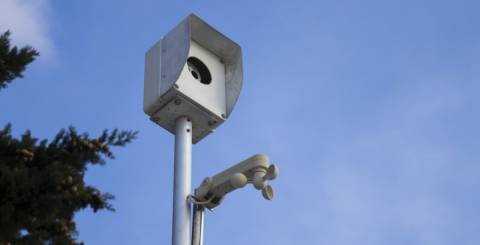
A solar-powered security camera on a remote job site runs on a closed loop: photovoltaic panels charge a battery bank during daylight, the battery runs the cameras and radios around the clock, and video moves off-site over a cellular connection rather than a wired network. Nothing plugs into utility power and nothing plugs into a building. That is the entire point, because most remote sites have neither for the first several months of work.
The part that trips people up is that the camera is the smallest piece of the system. What determines whether the setup actually survives a January in Montana or a dust storm in West Texas is panel wattage, battery chemistry and capacity, power draw at night, and signal strength at that specific GPS coordinate. Get those four right and the camera choice is almost incidental.
What Is Actually Inside a Solar Camera Tower or Trailer
A typical mobile unit carries somewhere between 300 and 800 watts of solar panels, often two to four rigid panels mounted on an adjustable frame so the tilt can be set for latitude and season. Those feed a charge controller, almost always MPPT rather than the cheaper PWM type, because MPPT harvests meaningfully more usable energy in low light and cold conditions. The controller manages the battery bank, which might be sealed lead acid on older units or lithium iron phosphate on newer ones.
Battery capacity is usually expressed in amp hours at 12 or 24 volts, and the practical range for a serious jobsite unit sits between 200 and 600 amp hours. Lithium iron phosphate costs more up front but tolerates deep discharge and cold far better than lead acid, which loses a large share of its usable capacity below freezing and hates being drained past half. If you have ever seen a solar camera die at 4 a.m. in December, this is almost always the reason.
Above that sits the mast. Trailer-mounted towers commonly telescope from around 15 feet to 25 or 30 feet, which matters because height buys sightline over stockpiles, containers, and stacked material. The cameras themselves are usually a mix of fixed multi-sensor units for wide coverage plus a pan-tilt-zoom camera for following movement, along with infrared or white light illuminators, a speaker for audio warnings, and a cellular router.
How the Cameras Keep Running Through Winter and Bad Weather
Solar sizing is not built around a sunny day. It is built around the worst realistic stretch, meaning three to five consecutive overcast days in the shortest part of the year. A well specified system carries enough stored energy to run at least 72 hours with no meaningful charge, and better ones stretch past a week.
Winter is the hard case for two reasons. Daylight hours shrink, and the night load is longer and heavier because infrared illuminators and heaters draw current for fourteen hours instead of eight. Panels themselves are actually more efficient in cold air, so the losses come from angle, snow cover, and shorter days rather than temperature. A steeper panel tilt in winter both catches the lower sun and helps snow slide off.
Power management does the rest. Rather than streaming continuously, most units run analytics on the device and only push video when something triggers, which cuts cellular radio time dramatically since the modem is often the single largest consumer after the illuminators. This is also why live monitored solar security cameras are configured differently from record-only units, since a system built to send an operator a verified alert has to reserve power for the moments that matter rather than spending it evenly across the night. Industry field experience suggests that most solar camera failures on remote sites trace back to undersized batteries or unmanaged night loads rather than the panels themselves.
Getting Video Off a Site With No Internet
Cellular is the default. A unit with a 4G LTE or 5G modem and an external high-gain antenna can usually hold a workable connection at signal levels where a phone struggles, and many carry dual SIM support so the router can fail over between carriers when one has a dead zone at that location. Data consumption depends entirely on configuration, but an event-driven setup typically lands somewhere in the range of 10 to 60 gigabytes a month per unit, while continuous high-resolution streaming can multiply that several times over.
Where there is genuinely no cell coverage, which still happens on pipeline corridors, mine access roads, and remote solar farm builds, the alternatives are point-to-point wireless bridges linking back to a site trailer with connectivity, or satellite. Low-earth-orbit satellite service has made this far more practical than it was five years ago, though it adds meaningful power draw to a system that was already budgeted tightly.
Storage sits on the device too. Local recording to an SD card or small solid-state drive gives you 14 to 30 days of retention depending on resolution, with clips pushed to cloud storage when an event fires. That hybrid approach means a dropped connection does not mean lost footage, which matters when someone asks for video from a Tuesday three weeks ago.
Read more: How to Troubleshoot and Maintain Your Home Security Cameras
What This Actually Costs and How It Compares to a Guard
Purchase prices for a trailer-mounted solar tower generally run somewhere between $12,000 and $30,000 depending on camera count, mast height, battery capacity, and whether analytics are included. Most contractors rent instead, and monthly rates commonly fall in the $800 to $2,500 range per unit, which usually bundles delivery, setup, connectivity, and some level of software access. Add live monitoring and the figure moves toward the upper end and beyond.
Compare that to a security guard at $25 to $45 an hour. A single guard covering nights and weekends runs well past $10,000 a month, and one person cannot watch four corners of a twenty-acre site at once. The camera math works because the fixed cost stays flat whether the site is a half-acre infill lot or a linear utility corridor.
Coverage needs vary a lot by segment, though. A residential subdivision builder often gets by with one unit at the entrance and material staging area, while a solar farm or data center build might need six to ten units repositioned every few weeks as work moves across the parcel. Utility and pipeline work leans on units that are easy to tow daily. Equipment yards and laydown areas, which sit static for months, usually get pole- or container-mounted systems instead of trailers because nothing needs to move.
The other decision factor is whether anyone watches the feed. Recorded video documents a theft, but a live operator who can trigger a speaker warning and call police while someone is still cutting the fence prevents one, and that difference tends to show up quickly on sites with repeat incidents. Deterrence happens in the moment, or it does not happen.
Before you commit to any configuration, check the actual sun exposure at the spot where the unit will sit. A tower parked on the north side of a six-story shell, or under mature trees at the property line, will underperform its spec sheet no matter how good the hardware is, and the fix is usually as simple as moving it forty feet or running a remote panel array. Walk the site at the time of year you will need it most, and place for winter rather than for the day you set it up.
Similar Articles

Road transportation is entering a period of major change. For decades, progress on the road was mainly associated with better engines, improved highways, and safer vehicle designs.

Most iPhone users feel pretty good about their privacy. They've gone through the settings, turned off location access for apps that don't need it, and tapped "Ask App Not to Track" whenever a prompt appeared

As more companies monitor productivity remotely, the risk of violating digital privacy laws grows
Stripe has set the gold standard for online payments. But in 2025, businesses that process large volumes of transactions, seek full control over their infrastructure, or want to reduce dependency on third-party platforms are seriously considering building their Stripe-like payment gateways.

Keeping pets safe is a top priority for dog owners. With advancements in technology, taking care of man's best friend has become more manageable and sophisticated. Among such developments, the incorporation of GPS tracking systems has revolutionised how owners look after their dogs.

What happens when standard cameras fail in the face of extreme radiation?
Over time, truck or auto fleet tracking has grown in popularity and value. A fleet tracking device is an updated, computerized gadget that gathers data from the whole fleet to provide a complete picture of where each truck is. It not only records the truck's position but also its fuel usage, mileage, and driving history, among other things.

A vehicle tracking system provides several advantages to your business, including increased driver and vehicle safety, decreased costs, and improved productivity.

Parents worry about their children while they're away from home. It doesn't matter where your children are or what they are doing. Parents can monitor their children remotely using child tracker devices