

AWS Big Data Solutions: Features and Benefits
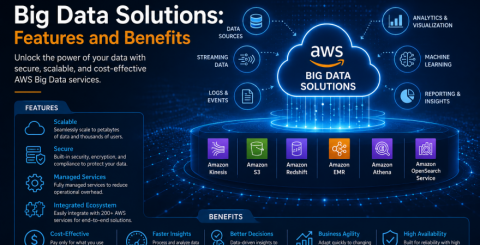
Modern businesses produce large amounts of data daily. Be it from customer transactions, Internet of Things (IoT) sensors, or countless other such sources. To derive business value from this data, organizations need infrastructure that can ingest and analyze data on a scale. After all, organizations today are starting to look to leverage data as their new source of insight. And gaining insights from data using ML models, real-time analytics, etc. is how most businesses want to consume data.
However, most companies are struggling to collect this data affordably. On-premises hardware is expensive to build out and maintain. Traditional hardware also does not scale well when your business experiences spikes in data. This is where AWS comes in, providing customers with a wide variety of tools. The kind of tools that are optimized for working with big data. By leveraging these services in the AWS cloud, customers can process large amounts of structured and unstructured data. Customers can also scale capacity up and down as needed, reduce total cost of ownership, and run their big data workloads in a secure environment.
In this blog, I will discuss how AWS Big Data Solutions work, along with key features and capabilities of AWS in managing big data.
How AWS Big Data Solutions Work?
It fundamentally separates storage from compute engines and treats data like a continuous, automated lifecycle. Breaking big data processing down from a single application to logical stages allows AWS users to continually feed raw data from applications, IoT sensors, etc. into a central repository a.k.a. a data lake. Amazon Kinesis can be used to stream live data feeds or AWS Data Migration Service (DMS) can be used to batch load and move data into Amazon S3 storage.
Once the data is staged, serverless orchestration services will catalog your data and kick off processing. Compute engines like Amazon EMR or Amazon Redshift isolate the data and transform it from basic unstructured files into query-optimized datasets. The processed data is then staged in the consumption layer where BI solutions such as Amazon QuickSight and ML algorithms can derive business value from stored information via business reporting and prediction modeling.
Key Features And Capabilities Of AWS In Managing Big Data
Amazon Web Services offers a comprehensive ecosystem of cloud-based tools and services designed to simplify big data storage, processing, analytics, and scalability. Its advanced capabilities help organizations manage massive datasets efficiently while improving performance, security, flexibility, and real-time decision-making across diverse business operations.
Listed are core features & capabilities of AWS to manage big data;
- Data ingestion: Getting your data onto AWS involves pulling or tapping raw data streams from outside sources and moving them into AWS environments. Interestingly, getting your data to the storage destination can happen in several ways. Amazon Kinesis allows data streams to be ingested for near real-time processing. This means your business can take actions on information as soon as it's available. AWS Data Migration Service (DMS) and AWS DataSync automate migration of large batches of historical data or operational relational databases with near zero downtime from on-premises storage appliances directly to AWS.
- Data warehousing: These technologies are used to house structured data from several lines of business to run complex queries and create BI reports. AWS' data warehousing enables organizations to combine information from across disjointed silos into one cohesive architecture. And this architecture is tuned specifically for reporting workloads, not everyday processing. Warehousing also separates out warehouse workloads from production databases. This allows large analytical queries against vast amounts of historical data, without impacting the performance of transactional systems that consumers rely on.
- Redshift: This one is Amazon's petabyte-scale, enterprise data warehouse service. It is built to speed up analytical queries using features such as columnar storage. Doing so can drastically reduce disk I/0 by only querying attributes needed to complete the query. Redshift also uses Massively Parallel Processing which shuffles data and query workload to many compute nodes that run processes concurrently.
Final Thoughts
AWS Big Data Solutions help organizations efficiently store, process, and analyze massive volumes of structured and unstructured data using scalable cloud infrastructure. With advanced analytics, real-time processing, and flexible services, AWS enables businesses to reduce costs, improve decision-making, and unlock greater value from data-driven operations. Ready to rope in AWS to help with your big data? Then I suggest that you start looking for a custom AWS development services expert at the earliest.
Similar Articles

Field sales teams handle numerous responsibilities every day. Sales representatives travel between customer locations, conduct meetings, collect orders, record information, and report their activities to managers.

The app development market has evolved significantly over the past decade or so. Its impact on business has been equally consequential.

Offshore IT hiring means recruiting IT professionals who work from another country or region. Companies commonly use this approach for software development, QA, IT support, DevOps, cybersecurity, data, and project management.

By 2026, moving to the cloud is no longer merely a competitive advantage. It is a business necessity. Every organization across the broad spectrum of industries will be challenged to become more agile.

Real-time dashboard showing multi-level commission tracking and distributor performance metrics

Digital transformation initiatives are no longer unheard of in the corporate world. As a matter of fact, it is also well known that companies expanding their digital footprint tend to run into crippling legacy apps.

The financial aid office has become one of the most operationally strained departments on the modern U.S. campus. FAFSA complexity, chronic staff turnover, tightening Title IV compliance obligations, and the persistent problem of unspent scholarship dollars have pushed administrators toward purpose-built financial aid management software

The demand for software delivery has never been higher. Applications must be delivered faster and on a scale like never before.

Businesses today need to ship new software faster than ever. That's not news, of course. Anyway, because of the demands on businesses, new solutions are being built on top of micro-services, serverless functions, etc.