

What Does a Wood Planer Do? The One Machine Rough Lumber Cannot Skip
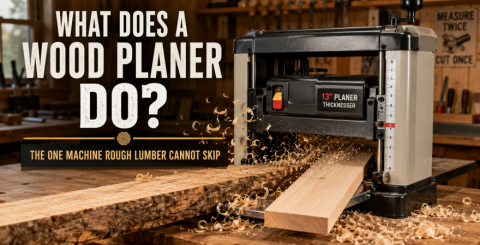
Rough lumber almost never arrives flat, smooth, or a consistent thickness. A board fresh off a sawmill might vary by an eighth of an inch from one end to the other, with saw marks still visible across the surface. Before any serious joinery can happen, that board needs to be milled into something usable. So what does a wood planer do exactly? Understanding its job clearly, along with its limits, makes the difference between buying the right tool and being disappointed by the wrong one.
What Does a Wood Planer Do: The Core Function
Before looking at types and components, it helps to pin down the one job a wood planer is actually built to perform, since this is where most beginner confusion starts.
Making both faces parallel
A thickness planer takes a board with one flat reference face and mills the opposite face so the two sides run perfectly parallel to each other. The board enters at one thickness and exits thinner, but evenly so along its entire length, which is the part hand sanding cannot reliably replicate. Without a planer, achieving that same evenness by hand would require constant measuring and remeasuring across the full length of the board, a process that takes far longer and rarely produces the same precision.
Bringing the board to a target thickness
Beyond flattening, a planer dials in an exact thickness measurement. Most benchtop models remove between 1/32 and 1/16 of an inch per pass, so a board can be brought down from three-quarters of an inch to a precise five-eighths over a few passes, with the same result repeated across every board in a batch. This matters most when a cut list calls for a specific dimension that standard lumberyard stock simply does not offer.
How a Wood Planer Works
The mechanics behind what a wood planer does are straightforward once the three working parts are understood, and each one plays a distinct role in the cut.
The cutterhead
A rotating cylinder fitted with knives sits above the board and removes material as the wood passes beneath it. The type of cutterhead installed has more effect on surface quality than any other single factor in the machine, often more than the brand or motor power of the planer itself.
Cutterhead Type
Surface Quality
Noise Level
Straight Knife
Good, more prone to tear-out on figured grain
Louder
Helical/Spiral
Excellent, minimal tear-out
Quieter
A straight knife cutterhead costs less and works fine on straight-grained lumber, while a helical or spiral cutterhead produces a noticeably smoother finish on figured wood at a higher price point.
Infeed and outfeed rollers
Rollers grip the board on either side of the cutterhead and pull it through the machine at a steady rate. Uneven roller pressure is one of the most common causes of snipe, a shallow dip cut into the first or last few inches of a board, and is usually fixed by supporting the board level with infeed and outfeed stands rather than letting it droop under its own weight.
The adjustable table
A height crank raises or lowers the table relative to the cutterhead, which sets exactly how much material comes off with each pass. This is the only control most users need to adjust during normal operation, though some models also offer a feed-speed setting that trades speed for a finer finish on the final pass.
What a Wood Planer Cannot Do
Understanding the limits is just as important as understanding the function, since a planer is frequently expected to fix problems it was never designed to solve.
A planer cannot flatten a warped, cupped, or twisted board on its own, because the feed rollers press the wood flat temporarily as it passes through, and the board can spring back toward its original shape once it exits. The cutterhead is only removing material relative to whatever the rollers are holding flat at that moment, not relative to the board's true, relaxed shape. It also cannot square an edge to ninety degrees or clean up the sides of a board, since the cutterhead only ever engages the top face. Both flattening a warped face and squaring an edge belong to a jointer, which is why the two machines are almost always used together rather than as substitutes for one another in any serious milling workflow.
Wood Planer vs Jointer: Where Each One Fits
Since the planer depends on having a flat reference face to begin with, its relationship to the jointer is worth laying out clearly.
Task
Wood Planer
Jointer
Makes both faces parallel
Yes
No
Reduces overall thickness
Yes
No
Flattens a single warped face first
No
Yes
Squares an edge to 90 degrees
No
Yes
A board typically goes through the jointer first to create that flat reference face, then through the planer to bring the opposite face parallel and reach the final target thickness.
Why the order matters
Running a board through the planer before jointing it produces a board that is evenly thick but still warped, since the machine simply mirrors whatever shape it was fed. Jointing first establishes a true flat face, and only then does the planer's job of creating a parallel second face actually result in a flat, usable board.
Where the Planer Fits in Real Shop Work
Beyond the technical answer to what does a wood planer do, the machine earns its place in a shop through the practical problems it solves on a regular basis.
Working with rough-sawn and reclaimed lumber
Rough-sawn lumber from a sawmill costs noticeably less than surfaced S4S stock, often by a wide margin per board foot, and a planer is what makes that price difference usable rather than just theoretical. The same applies to reclaimed wood such as old barn boards or pallet material, though hidden nails or embedded grit in reclaimed lumber can chip a cutterhead fast. A quick pass with a metal detector or a careful visual check before milling catches most of these hazards, but damage still happens occasionally, which is why keeping a spare set of Planer Knives from Sheartak Tools on hand saves a project from stalling mid-build.
Dimensioning lumber to a project spec
Plans often call for a specific thickness that off-the-shelf lumber does not match exactly, whether that is a three-quarter-inch panel that needs to come down to five-eighths or a thicker leg blank glued from two boards. A planer lets a woodworker dial in that exact dimension instead of working around whatever thickness the lumberyard happens to stock, and it does so consistently across every piece in a cut list rather than one board at a time by hand.
How Often a Wood Planer Needs Attention
Knowing what does a wood planer do for daily use also means knowing what it needs in return to keep performing at that level over time.
Watching for dull or chipped knives
Tear-out, fuzzy surfaces, or a sudden increase in feed resistance are the clearest signs the cutterhead knives have lost their edge. For regular hobby use, checking the blades every 15 to 20 hours of cutting time catches dullness before it shows up in a finished project. Hardwoods and gritty reclaimed lumber wear down an edge noticeably faster than clean softwood.
Keeping the rollers and table clean
Resin buildup on the infeed and outfeed rollers reduces their grip, which can cause a board to stall or feed unevenly partway through a pass. Wiping the rollers and table down with a dry cloth after heavy use, and occasionally with a light solvent for stubborn sap, keeps the feed consistent and the surface finish predictable.
The Bottom Line
What does a wood planer do, in the simplest terms? It makes both faces of a board parallel and brings it to a consistent thickness. It depends on a jointer for the flat starting face, but together the two machines turn rough lumber into stock ready for real joinery work.
Similar Articles

Explore the critical role of advanced refrigeration locks in safeguarding product integrity and preventing costly spoilage in commercial settings.
When it comes to selecting a radiator for your home, the choices are vast and varied. From traditional cast iron designs to modern electric radiators, the options can fit any aesthetic or functional need you might have.

As electricity prices continue to rise, homeowners and businesses are under increasing

As someone who's tested countless Aerosol Cans over the years, from household cleaners to personal care items, I can tell you they're not just containers; they're reliable partners in our daily routines.

After the last box is carried in and the truck pulls away, a new challenge begins—surviving your first night in an unfamiliar home

In the fast-paced world of food service, maintaining a pristine kitchen isn't just about aesthetics - it's about safety, efficiency, and reputation. Commercial kitchens are subject to rigorous health and safety standards, and deep cleaning is crucial to meet these requirements.

So, you've just bought a brand-new AC compressor for your heavy equipment. Maybe your old one gave out during a heatwave on the jobsite, or maybe you’re just trying to stay ahead of the curve before summer hits hard.

In modern construction, woodworking, and DIY projects, power tools are indispensable. Both professional and home workshops use them for their efficiency, versatility, and ability to handle tough tasks.

When household appliances break down, the immediate reaction is often frustration. Attempting a do-it-yourself fix might seem like the quickest and most cost-effective solution. However, these attempts can lead to further damage, increased costs, and even safety hazards without the proper knowledge and precautions.