

Real-World Applications of Generative AI in Mobile App Development
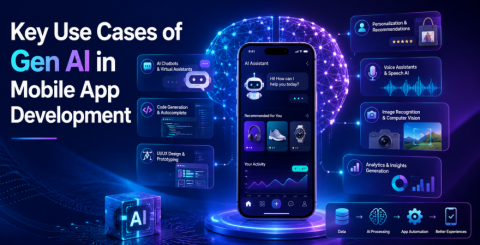
The digital world has always been evolving at a rapid pace. Ever since it first emerged. Take static applications, for example; their architecture is no longer agile enough to meet consumer expectations. In fact, such apps now even struggle to keep pace with competitive pressures. This has been the leading cause of a critical shift in the development ecosystem: adoption of AI assisted tools for mobile software development. Programmers tend to need plenty of help when dealing with complicated workflows.
And if you are looking to shorten the time it takes to get the applications to market, this becomes even more relevant. In fact, developers are turning to generative AI less as an experimental feature and more like a fundamental technical solution across the development lifecycle. To be more specific, development teams now use gen AI models to not only write boilerplate code but also automate UI test suites and deliver personalized interfaces for end-users. It has become abundantly clear that putting generative AI to work for your mobile app development project helps reduce development costs. It also keeps the app continually adapting to your end users’ unique behavior.
In this blog, I will discuss the use cases of Generative AI in mobile app development with some specific ways you can systematically apply generative AI to your app development process.
Generative AI Use Cases in Mobile App Development
Generative AI is reshaping mobile applications from static digital interfaces into intelligent, adaptive experiences. From personalized content and conversational assistance to automated content creation and smarter recommendations, its potential spans industries and user needs. Let’s explore some noteworthy use cases where Gen AI is helping businesses build more engaging, intuitive, and value-driven mobile applications.
Listed below are key use cases;
- Code generation and optimization: Generative AI always sit in your editor and turn natural language specifications into working platform native code. These models are also able to generate common infrastructure scaffolding such as networking APIs, route controllers to wire up navigation logic, etc. Beyond generation, gen AI can understand your existing code and help identify latent design problems by finding memory leaks and main thread blocking among other such issues. It takes it a step further and can suggest altered implementations that use less CPU and decrease battery drain on the device.
- Smarter automated testing: Manual authoring of test scripts remains a massive bottleneck since apps must be tested across multiple devices, OS versions, etc. Thankfully, generative AI is here to make things easy. It can read software requirement documents and UI wireframes to automatically generate end-to-end test-scripts. In addition to that, synthetic data can be generated to test business logic while remaining compliant with relevant regulations. Generative vision AI can be used to detect visual regressions by examining screenshots of the app on different screen sizes for potential issues such as misalignment, overlapping text boxes, etc.
- Self-healing test systems: Mobile interfaces are known to cause automated regression suites to fail often due to updates to resource IDs and even screen positions. Self-healing test automation helps address this challenge by integrating gen AI models into the test workflow. So, if a UI element changes during test execution, the model looks at other features around the element to re-identify the element it was looking for. The test script locators are then updated on the fly so the test can complete
- Quicker app design and prototyping: Generative AI significantly accelerates these processes by transforming text prompts or crude wireframes into ready to use layout files, design tokens, etc. ready for production in frameworks. Design and product teams can then quickly create many UI variations and iterate from idea to clickable prototype with barely any manual effort.
- Hyper personalized user experiences: Deploying generative AI-driven mobile apps is conducive to experiences that learn from and adapt to how each user interacts with the app. It also helps adapt in accordance with what's happening around the users and where they are. Built-in generative models can power apps that offer personalized product suggestions and drive natural-language multimodal assistants to name a few things off the top of my head.
Final Words
Generative AI is redefining mobile app development by accelerating coding, testing, design, and personalization. When applied strategically, it can help development teams reduce manual effort, improve application quality, and shorten time to market. As these capabilities continue to mature, businesses that integrate Gen AI thoughtfully can build smarter, more adaptive, efficient, and user-centric mobile experiences. Finally, Gen AI brings truly immense potential to the table, does it not? What are you waiting for then? Go and start looking for a trusted partner for generative AI development services ASAP.
Similar Articles
Building an AI model is only one part of creating a system that works in practice. Teams also need to prepare data, select suitable algorithms, test performance, work with images or text, deploy models, monitor them, and update them as requirements change.

Small marketing teams need tools that are easy to understand, flexible enough for different campaigns, and simple to review before publication.

Short-form storytelling requires more than attractive visuals. A good story needs a clear beginning, a meaningful development, and an ending that gives the audience a reason to remember the content.

Discover how AI is transforming customer service by handling routine enquiries, improving routing, assisting employees and helping businesses spot patterns.

AI visual tools help solo creators generate thumbnails, images, and video fast—cutting design time without sacrificing quality or workflow.
Most people encounter "swap" tools as a single category. A video goes in, a different person comes out, and the marketing rarely bothers to explain what was actually exchanged.
In recent years, fluctuating raw material costs, pervasive labor shortages, and other such challenges have created a perfect storm for manufacturing organizations.

A content idea can be clear in your head and still become difficult the moment it needs a visual.

Explore MLOps vs LLMOps and learn how enterprise teams deploy, monitor, and scale AI systems in 2026 with smarter workflows and reliable operations.