

Key Benefits of Choosing the Right Custom Software Development Company for Your Business

The U.S. Government Accountability Office (GAO) found that the agency in charge of Healthcare.gov did not develop a required acquisition strategy to identify risks and plan for them, and that it issued task orders before key requirements were known.
Spending obligated for the main marketplace system rose from $56 million to more than $209 million. Most businesses will never build anything that large, but the pattern is familiar. Which custom software development company you hire shapes your budget and your timeline more than any single technical decision, and the right one gives you the benefits below.
7 Key Benefits of Right Custom Software Development Company
Developing custom software is no small task and requires ample support for smooth processes. Thus, choosing a partner that you can rely on at every stage is essential, and it offers several other benefits too (other than support, of course!)
Software that fits how you work
Off-the-shelf software is built for the average customer. If your process is different, you adapt to the tool, or you pay for workarounds. Good teams reverse that order. They start with your sales flow and your approval steps and build the software around them. A distributor, for example, can have its order system talk directly to its warehouse system, so a sale updates stock without anyone retyping it. That kind of fit is hard to buy in a box, and it is what custom software development services exist to provide.
Software is also where a growing share of company money goes. Gartner’s July 2026 forecast puts worldwide software spending at $1.468 trillion this year, up 15.5%. When that much spending is at stake, who builds your product matters.
Fewer surprises on cost and schedule
The HealthCare.gov review shows where overruns come from. The GAO also found that the agency did not use available information, such as quality assurance plans, to monitor contractor performance. In plain terms, the agency had information that could have flagged problems early and did not use it.
A good custom software development provider protects you from that. Ask how it estimates work, how often you will see working software, and what happens when scope changes. A team that demos a working piece every two weeks gives you a chance to correct course before money is spent in the wrong direction. A team that disappears for three months and returns with a finished product does not.
Pricing models change who carries the risk. Under a fixed price, the vendor carries it, so scope changes get argued over. Under time and materials, you pay for hours worked, so regular demos show what the hours bought. Ask any team offering custom software development services what happens when requirements shift, which they will, before you sign.
Security built in from the start
IBM’s Cost of a Data Breach Report 2026 puts the global average cost of a breach at $4.99 million, a record high and 12% above the previous year [3]. IBM attributes the rise to higher detection, escalation, and lost business costs.
Security built in from the start means the team checks the code for known weaknesses during development, encrypts sensitive data, and limits each user to the data their role needs. A strong custom software development company can show you how it does each of these on a past project, and will tell you which compliance rules, such as GDPR or HIPAA, apply to your data before writing any code.
Software that works with what you already run
Most companies already run an accounting package, a CRM, or an ERP, and a new product has to exchange data with them. Done well, your staff enter information once. Done poorly, you get a new system that sits beside the old ones and doubles the data entry. Teams that deliver custom software development services build the links through APIs, which are agreed formats for two systems to share data. Ask each vendor how it handled the day another system changed its data format.
A mobile app people keep using
Sensor Tower reports that consumers spent 5.3 trillion hours in apps in 2025, and in-app purchase spending reached $167 billion globally, up 10%. If your customers or staff are among them, a mobile product is part of the business.
Good mobile app development services begin with a choice you should understand. A native app is written separately for iPhone and Android, which gives the best access to phone features such as the camera and notifications. A cross-platform app shares one codebase across both, which usually costs less and ships faster. Neither choice is always right. The right team explains the trade-off using your users and your budget, and plans for offline use, since a patchy connection is a normal condition. It also plans for the app store review process, which can reject an update for reasons that have nothing to do with your code, so release dates need a buffer.
One team across web and mobile
When one team handles mobile app development alongside the web back end, both share one set of connections to your data, called APIs, and one source of truth. If different vendors build them, customers can see one price on the website and another in the app. That also means fewer meetings between vendors who each blame the other.
Ownership and support after launch
Launch is the start of the work. Operating systems update, phones change, and your business adds products. Ask who maintains the software afterward, what a fix costs, and how quickly the team responds to a serious bug. A custom software development company that treats launch as the finish line leaves you holding the bug list.
Ownership matters as much. Make sure the contract says your business owns the source code and the documentation. If you ever change teams, you should be able to hand over a clean codebase and not start again. Any team should say yes to this without hesitation. Ask for response times in writing too, for example, how many hours a critical bug can wait before someone starts work on it, and who is on call outside office hours. Apps need an update whenever iOS or Android ships a major release, so confirm that the team’s mobile app development expertise includes that maintenance in the quote.
How to tell you have found the right team?
Use these questions in your next vendor call:
- Can you describe a past project close to mine and what went wrong on it?
- How often will I see working software, and who approves changes?
- How do you test, and how do you handle security from the first sprint?
- Which apps from your mobile projects are live in the app stores today, and can I talk to that client?
- Who owns the code, and what does support cost after launch?
Answers from a team offering custom software development services should include dates, numbers, and named tools. Answers full of adjectives are a warning.
Parting Note
Pick the one process that costs your team the most hours each week and write down what a better version would do. Add a success measure, such as hours saved per week, so every vendor starts from the same brief, and the quotes can be compared fairly.
Then bring that page to two or three vendors, ask each to show a live app it built, and compare how each respond. The right custom software development company will ask you questions about the process before it quotes a price, and it will tell you what it would leave out of version one.
Similar Articles

Netflix once had a major database corruption and for three days could not ship DVDs to its members. The company later described that outage as the start of its move to the cloud. The lesson reaches well beyond streaming.
Marketing a complex manufactured product means making technical capability clear to several kinds of buyer.

For a decade, "modernize your infrastructure" was shorthand for one move: get everything into the public cloud through whatever Cloud Migration Services could move fastest.
On December 22, 2022, a winter storm hit the US. Thousands of flights were delayed, which happens every winter. What happened next wasn't normal. Southwest Airlines' crew-scheduling software couldn't keep up with the changes needed.

Most brands treat multi-channel marketing as a checklist: get on TikTok, run some paid social, send a few emails, maybe try SMS. The problem is that adding channels without integration doesn't multiply results - it just multiplies your workload while your margins quietly shrink

Picture this: you've closed a Series A, your product finally sticks, and churn has stopped keeping you up at night.
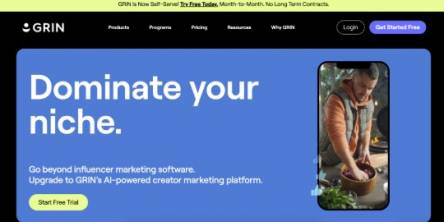
GRIN is a capable platform. But at $25,000 per year with a mandatory 12-month contract, it prices out a significant portion of the market it serves. Growing influencer marketing teams -

In the past, appliance repair technicians were able to thrive by simply gaining reputation locally. They relied on print ads, while word of mouth did the rest. However, that’s not how the word spreads nowadays.
Boost growth with expert digital marketing services—enhance visibility, target the right audience, increase ROI, and stay ahead of competitors.