

Exploring Top Applications of AI in Mortgage Underwriting
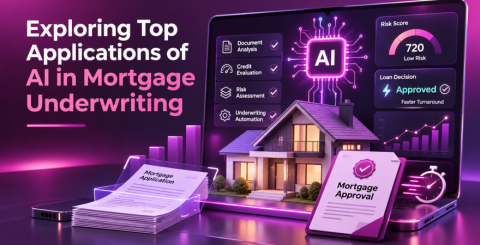
The mortgage industry across the globe has been struggling for quite some time now. The reasons? Plenty, including rising interest rates and heavy regulation. Hence companies operating in this sector are looking for means to decrease turnaround times and overhead costs. And all of this must be done without affecting the accuracy rates of their credit analysis. Suffice it to say that the mortgage underwriting process is riddled with challenges.
The kind of challenges that arise from the use of manual processes, such as for the review of hundreds of pages of documentation. An underwriter must also manually feed many of these documents into various legacy systems. Clearly not only does this take longer but you also run the risk of human error and higher cost per loan originated. No wonder then that companies are now turning to AI for mortgage underwriting. This tech can take in all types of data and help lenders better evaluate borrowers. AI also allows you to analyze even unstructured data and create a full package of information when assessing a customer's credit.
In this blog, I will discuss the different applications of AI in mortgage underwriting.
A Quick Guide to AI-Driven Mortgage Underwriting
Using AI to underwrite mortgage loans means you use technology such as machine learning and NLP to analyze a borrower's loan information. AI helps you verify your customers' assets and documents. By using this technology to underwrite mortgages, lenders process several documents and data points in mere seconds. Then this information helps appraise collateral and sometimes even catch any signs of fraud.
AI Mortgage Underwriting: Notable Use Cases
AI is transforming mortgage underwriting by enabling lenders to assess applications faster, improve risk evaluation, and make more informed lending decisions. From automated document processing to predictive credit risk analysis, AI offers several practical use cases that streamline underwriting workflows, enhance accuracy, and improve the overall borrower experience.
- Data entry automation: AI mortgage underwriting software uses OCR, NLP, etc. to extract information from loan documents. The system then gathers all that data in one place before channeling it into your loan origination system. This system then uses all these many data points and runs comparisons to ensure that they are all in order. The use of AI here also means fewer data is being handled manually and decreases time for data intake.
- In depth risk assessment: Yet another compelling way AI comes in handy in mortgage underwriting is determining if someone is credit worthy. AI systems use machine learning to look at all the data points that make up a borrower's financial profile. And the analysis is extensive too; i.e. it also includes analysis of data points such as monthly EMIs, job history, etc. This software can calculate many variables to help you determine DTI and LTV ratios. And once you feed it their loan history, you can also identify when a person is likely to default on their loan. Then you can adjust the mortgage offer and quality accordingly.
- Enhanced fraud detection: AI can also help fortify mortgage underwriting through the prevention of fraud. And how does that happen? That would be by analyzing all the documents uploaded along with the loan application. Through computer vision and forensics software, you can identify if any documents have been tampered out or not. But that is not all; AI can also help determine identity theft, find undisclosed debt, etc. All of these can be flagged when files are initially uploaded means stopping a fraudulent file in its tracks.
- Regulatory compliance: AI also helps lenders to strictly follow regulations when they process loans for their customers. Regulatory requirements can be built into policies for their underwriting process. These automated compliance programs then make sure that all disclosures are sent in a timely fashion. They will also ensure that approved loans meet all requirements laid out by government and industry agencies. And let's not forget that AI also creates an electronic audit trail for each automated process. That comes in pretty handy.
Concluding Thoughts
AI is transforming mortgage underwriting by streamlining document processing, strengthening risk assessment, improving fraud detection, and simplifying regulatory compliance. By integrating AI into underwriting workflows, lenders can reduce turnaround times, control operational costs, and improve decision-making accuracy while delivering a faster, more efficient, and reliable borrowing experience. Ready to embrace AI in your mortgage software development project? Then I recommend that you start with looking for an experienced service provider ASAP.
Similar Articles

Shopify order management is the work between a customer clicking pay and the parcel arriving: checking the order, picking stock, buying a label, shipping, and keeping the customer informed.

If you need to open an Exchange mailbox without the server that created it, an EDB-to-PST converter is usually the fastest way to get there.

Discover the 4 best iPhone system repair software tools in 2026, comparing features, ease of use, reliability, and recovery options to find the right fit.

Choosing the right electronic health record (EHR) system is an important decision for any medical practice. The right platform can simplify patient documentation, appointment scheduling, insurance claims, billing, and daily administrative tasks.

Running a restaurant involves much more than taking orders and serving food.

Field sales teams handle numerous responsibilities every day. Sales representatives travel between customer locations, conduct meetings, collect orders, record information, and report their activities to managers.
The app development market has evolved significantly over the past decade or so. Its impact on business has been equally consequential.

Offshore IT hiring means recruiting IT professionals who work from another country or region. Companies commonly use this approach for software development, QA, IT support, DevOps, cybersecurity, data, and project management.

By 2026, moving to the cloud is no longer merely a competitive advantage. It is a business necessity. Every organization across the broad spectrum of industries will be challenged to become more agile.