

EV Powertrain Explained For Mechanical and Electrical Engineering Students
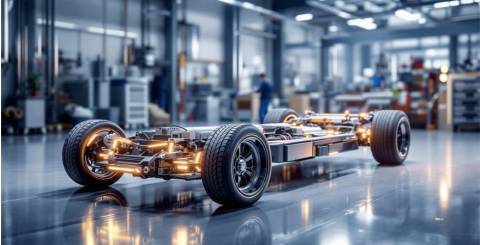
A Tesla Model 3 Long Range does 0–100 km/h in 4.4 seconds. It has one moving part in its drivetrain that you'd recognise from a conventional car: the differential. Everything else — the multi-plate clutch, the torque converter, the five-speed gearbox, the camshaft — is gone. What replaced all of it is a battery, an inverter, and a motor. Three components doing the work of thirty.
That's not marketing copy. That's an engineering trade-off with some very specific consequences, and understanding those consequences is what this article is about.
Why the Gearbox Disappeared
The internal combustion engine produces usable torque only in a narrow RPM band — roughly 1,500 to 4,500 RPM for most passenger car engines. Below that, it stalls. Above it, torque drops off. The gearbox exists entirely to work around this limitation, keeping the engine inside its useful range across vehicle speeds.
Electric motors don't have that band. A PMSM produces peak torque at zero RPM and holds it across a wide speed range before power naturally tapers off. So the gearbox — that entire mechanical compromise — reduces to a fixed single-speed reducer, typically 8:1 or 9:1, and a differential. Done.
Mechanical engineering students sometimes find this underwhelming. The drivetrain is almost boring compared to a dual-clutch transmission. But the complexity didn't vanish — it migrated upstream, into the power electronics and control systems.
The Inverter: Where the Real Engineering Lives
The traction inverter is the component most students underestimate. It sits between the battery and the motor and does something deceptively difficult: takes DC from a 400 V or 800 V battery and synthesises a smooth three-phase AC waveform — continuously adjusting phase, amplitude, and frequency to command precise torque from the motor.
Switching happens at 10–20 kHz. At full load, the thermal flux inside the inverter module is severe. This is why newer platforms — Hyundai's E-GMP, for example — are moving to silicon carbide MOSFETs instead of silicon IGBTs. SiC switches faster, runs hotter, and wastes less energy doing it. The efficiency gain at the inverter level flows directly into range.
If you've studied PWM in your power electronics module, you already understand the mechanism. The inverter is where that coursework shows up in a product you can actually buy.
Field-Oriented Control — The Part That Ties It Together
FOC is why the ev powertrain responds the way it does. The algorithm runs on a DSP inside the inverter, decoupling the motor's torque-producing current (Iq) from its flux-producing current (Id), and controls each independently in real time. The loop reads rotor position, samples phase currents, applies Clarke and Park transforms, runs PI controllers, inverts the transform, and outputs PWM — all in microseconds, continuously.
Torque commands execute in under 10 milliseconds. That speed is what makes traction control, torque vectoring, and stability intervention actually work. It's also what makes EV acceleration feel different from a fast petrol car — no turbo spool, no valve float, no mechanical lag. The response is immediate because the control loop is tight.
If signals, control theory, and power electronics have felt like separate subjects — FOC is where they merge into one problem.
Regeneration Changes How the Whole System Is Sized
During braking, the motor runs as a generator. Kinetic energy back-drives the shaft, current flows back through the inverter, the battery charges. NREL's EV energy recovery research puts regenerative capture at 15–30% of energy that conventional friction braking wastes as heat — a wide range because drive cycle and vehicle mass matter enormously.
That figure isn't a footnote. It determines battery charge acceptance specs, inverter bidirectionality requirements, and how brake-by-wire blending logic is tuned. The ev powertrain is designed around regeneration — it isn't bolted on later.
For a thorough breakdown of architectures, component specs, and where efficiency headroom remains, this ev powertrain reference covers it in useful depth.
The Efficiency Gap, and What's Still Closing It
Battery-to-wheel efficiency in a modern ev powertrain sits around 85–92%. A petrol engine under real driving conditions converts roughly 20–35% of fuel energy into motion — the rest leaves as heat. That gap isn't closing from the ICE side.
What's still improving on the EV side: SiC inverters, tighter motor-inverter integration, and heat pump cabin heating replacing resistive elements that used to punish cold-weather range. The IEA Global EV Outlook documents consistent improvement in average energy consumption per kilometre over the past decade, with powertrain refinements a steady contributor.
Why This System Rewards Cross-Domain Thinking
Most engineering systems live in one domain. The ev powertrain doesn't. Torque ripple from the motor creates NVH issues the mechanical team owns. Thermal limits on the inverter constrain how aggressively the controls team can tune torque response. Battery internal resistance shapes what regeneration can actually recover.
The handoff points between electrical and mechanical are where the interesting problems sit. Lab exposure helps here more than most coursework does — logging inverter waveforms during a loaded run, measuring regen current across deceleration profiles. That's where the theory stops being abstract.
Similar Articles

Learn how to make informed decisions for your vehicle by comparing costs, features, maintenance needs, safety, reliability, and long-term value.

Most people who end up buying a caravan or motorhome spent months thinking about it before they w

Learn how to pick the right UTV door—lower, half, full, or convertible—based on fitment, terrain, weather, and riding style.

Explore new dirt bike models, key features, and expert buying tips to choose the right ride for performance, durability, and off-road adventures.
The interaction between alcohol ignition interlock devices and insurance coverage is an important consideration for those who have been mandated to install such devices.
Custom van racking helps tradespeople stay organized, protect tools, and work faster. Learn how vehicle-specific systems improve efficiency.

Car accidents can be stressful and overwhelming, often leaving drivers with damaged vehicles and uncertainty about the next steps.

Discover why the Bajaj Chetak C2501 is perfect for eco-conscious commuters—stylish, efficient, low-emission, and ideal for sustainable urban travel.

This is the first thing that most people overlook: the car parked in your driveway was designed with a generic driver that does not exist anywhere on Earth.