

Top Technologies Used In Smart Factories
Digital transformation is leading the way in reshaping the factories of the future. The term smart factories or industry 4.0, enables manufacturers to refine production processes, manage global market competition, and realize significant returns. The ultimate objective of this transformation is to boost efficiency, flexibility, design, and integration. These transformative technologies are set to offer unrivaled opportunities for growth and competitiveness.
In this article, I will explore the various top technologies such as the cloud, IoT, Artificial intelligence (AI), Machine Learning (ML), and more that are being used to create smart factories.
How Transformative Technologies Are Creating Smart Factories
- Cloud integration: Cloud integration helps connect various cloud-based systems such as private, public, or hybrid cloud, to enable communication, coordination and data sharing, and this integration helps create smart factories. Cloud integration can provide a flexible, cost-effective and scalable platform for manufacturing services and applications. The cloud platform integration can help collect, analyze, and visualize data in real-time. The source data can be collected from sensors, devices, machines, assets, and even the workforce. It can help in communication and collaboration between the various stakeholders, and allow innovation and customization while adapting to the changing market requirements.
- Artificial intelligence (AI) and Machine Learning (ML): Factories or manufacturing facilities using AI technologies find that they have the flexibility and the speed to gather and analyze big data from multiple sources. This helps in identifying patterns and trends, enabling stakeholders to gain insights into the production performance process. Artificial intelligence when paired with machine learning can do wonders and bring about visible and valuable benefits. Predictive maintenance is one of the biggest advantages of using ML. Using ML to monitor and analyze manufacturing processes can help identify faults and trigger alerts before any system failure. These triggers can also send our alerts for automated maintenance or ask for human intervention where needed.
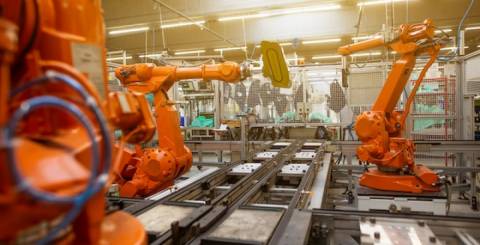
- Automation and Robotics: For years, robotics and automation have been revolutionizing the manufacturing industry, and this is a trend that will likely continue. Robotic process automation has been instrumental in advancing smart manufacturing, with robots assuming repetitive and potentially hazardous tasks such as assembly, and material handling. Robotic technology can execute repetitive tasks more quickly and with greater accuracy and precision than human workers, enhancing product quality and minimizing defects. Manufacturers can also merge robotics with Industrial Internet of Things (IIoT) sensors and big data analytics to establish a more adaptable and reactive production environment. Robotic automation can enhance system efficiency, minimize errors, reduce equipment downtime, and promote worker safety in manufacturing operations. An additional advantage is that robots can operate continuously, enabling manufacturers to function 24/7 and significantly boost productivity.
- Industrial Internet of Things: Industrial Internet of Things or IIoT, is a term that is used for connected sensors or devices in an industry or factory. IIoT helps improve efficiency through the process of automation and self-monitoring. IIoT can record and optimize production, by balancing supply and demand. IIoT can help automate operations by giving a real-time status of equipment and their performance using dashboards that allow operators to make data-based informed decisions.
- Sustainable manufacturing: Manufacturing processes frequently demand substantial energy and water resources and can often generate harmful waste and by-products. This has led to sustainability initiatives gaining traction in modern manufacturing processes. Today consumers exhibit heightened environmental awareness, and governments persist in enforcing regulations to curtail carbon emissions and safeguard the environment. This increases manufacturer's responsibility to alleviate climate change impacts by striving for carbon neutrality and reducing their carbon footprints. Companies committed to sustainable manufacturing attempt to diminish waste, preserve resources, and limit the utilization of harmful substances. They achieve this by harnessing renewable energy sources, embracing the principles of the circular economy, and launching environmentally friendly production processes.
- Blockchain: The blockchain is an unchangeable or immutable, shared ledger that enables recording transactions and tracking assets within a network. Anything that signifies any value such as a car, cash, intellectual property, or patents can be tracked. It reduces risks and helps cut costs by removing the middleman. Modern businesses run on the power of data and information, where its speed and accuracy count the most. Blockchain is the ideal tool for transmitting that information, as it can provide shared and transparent information that can be accessed only by those within the network who have permission to access the data. Blockchain reduces the manual paperwork, and processes and eliminates the need for intermediaries, helping save time and costs. It can be used to generate smart contracts and asset tokenization.
- 3D printing: 3D printing or additive printing uses digital designs as guides to create products from scratch, on demand. This technology is perfect for prototyping, and manufacturing small batches of items. It is ideal for developing parts and functional prototypes, along with items that require high detail. Because it can ‘print’ items, it is now possible to create complex geometrical products that would have been difficult to develop before. The technology uses different processes, techniques and raw materials that can be used in metal and plastic products. Some of the techniques of 3D printing are vacuum casting, fused deposition modeling (FDM), and multijet fusion. Additive printing is a game changer and allows manufacturers to offer customization and personalization to their customers.
Final Words
The use of transformative technologies like cloud computing, IIoT, additive printing and Blockchain are revolutionizing the manufacturing process and paving the path for smart factories of the future. The technological transformation in smart factories is a dynamic and ongoing process, where manufacturing software development services can help companies of any size harness the potential of such technologies.
Similar Articles
Managing multiple documents can quickly become frustrating. Imagine sending several files in an email, uploading different attachments to a submission portal, or sharing a business report with clients across multiple documents.

Energy efficiency is revolutionizing power distribution, leading to more sustainable and cost-effective energy systems.

Moving has a way of making even organized people feel scattered. One minute you’re labeling boxes. The next, you’re hunting for a receipt, calling the utility company, and wondering where the tape disappeared to.

Apple devices break more than owners expect. This guide shows the cases, screen protectors, and Apple Watch bands that stop cracks, scratches, and costly repairs, plus how to change apple watch band in under a minute.

The aviation industry is rapidly modernizing, shifting from reactive, paper-heavy maintenance to highly automated, predictive ecosystems.

Learn what makes users trust a health app instantly and discover the design, security, and user experience factors that drive long term engagement.
Learn how Thunderbolt 4 docking stations support multiple displays, deliver fast data transfer, and create a streamlined, productive workspace.

Learn how ML development teams measure ROI from machine learning investments by tracking revenue growth, cost savings, productivity gains, risk reduction, and long-term business outcomes.

Whether you are storing personal photos, school projects, work documents, or business files, cloud storage makes it easy to access your data from anywhere with an internet connection.