

Top 5 Ways to Control Crawl Space Moisture: Drainage, Vapor Barriers, and Dehumidification

Moisture problems in a crawl space can affect more than the area beneath your home. Excess humidity can contribute to musty odors, condensation, wood deterioration, and mold growth. Over time, damp conditions may also affect indoor comfort because air from the crawl space can circulate into the living areas above.
Fortunately, homeowners can often manage crawl space moisture by combining effective drainage, a properly installed vapor barrier, and suitable dehumidification. The right approach depends on the source of the moisture, the amount of water entering the space, and whether the crawl space is vented or enclosed.
Here are five practical ways to control crawl space moisture and help protect your home's structure.
1. Improve Drainage Around Your Home
Effective drainage is the first step in preventing excess water from entering a crawl space. A dehumidifier can remove moisture from the air, but it cannot solve persistent flooding or significant groundwater intrusion.
Start by inspecting the ground around your home's foundation. The soil should generally slope away from the building so rainwater does not collect near the foundation. Check gutters and downspouts to ensure they are clear of debris and direct roof runoff away from the structure.
If water continues to enter the crawl space, additional drainage solutions may be necessary. Depending on the property's conditions, these could include interior perimeter drains, a sump basin with a pump, or other professionally designed water-management systems.
Before installing new drainage equipment, inspect the area for plumbing leaks, damaged pipes, soil depressions, and signs of groundwater intrusion. Persistent water problems should be assessed by a qualified professional to reduce the risk of structural damage or improper water diversion.
2. Install a Durable Vapor Barrier
Even without standing water, exposed soil can release water vapor into a crawl space. A vapor barrier helps reduce this moisture source by covering the ground with a suitable low-permeance material.
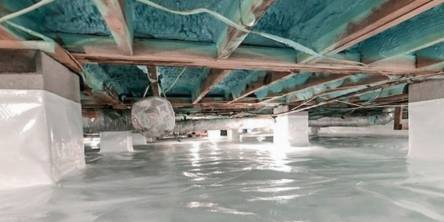
Polyethylene sheeting is commonly used for this purpose. The material should cover the exposed soil, with seams overlapped and sealed according to the product's installation instructions. Depending on the design, the barrier may also extend up foundation walls and around support piers.
Installation quality matters. Torn material, uncovered soil, gaps, and unsealed seams can allow moisture to continue entering the space. Choosing a durable product and checking its condition periodically can help maintain effective coverage.
In an encapsulated crawl space, the ground barrier may be combined with sealed foundation walls and appropriate humidity control. However, the design should account for local building codes, termite inspection requirements, and the condition of the existing structure.
A vapor barrier reduces moisture entering from the soil, but it does not eliminate every source of humidity. Drainage improvements and dehumidification may still be necessary.
3. Use a Crawl Space Dehumidifier
A crawl space dehumidifier removes excess water vapor from the air after major water intrusion problems have been addressed. It can be particularly useful in humid climates, enclosed crawl spaces, and homes where moisture levels remain elevated despite drainage and vapor barrier improvements.
Relative humidity is a useful measurement when evaluating moisture conditions. Many moisture-control plans aim to keep indoor relative humidity below 60%, although the ideal target depends on the building, climate, and operating conditions.
Before choosing a unit, consider the crawl space's size, height, current humidity, air leakage, temperature, and drainage arrangements. A unit that works well in a small, properly sealed space may not provide sufficient capacity for a larger area with significant moisture problems.
Homeowners comparing equipment can review this collection of crawl space dehumidifiers to understand available options. Compare moisture-removal capacity, operating temperature range, drainage requirements, maintenance needs, and installation specifications rather than relying only on advertised capacity.
A properly selected dehumidifier can help maintain more stable humidity levels, but it should complement drainage and ground moisture control rather than replace them.
4. Choose the Right Dehumidifier for Your Space
Selecting suitable equipment involves more than comparing product descriptions. The best unit should be capable of handling the actual moisture load while operating reliably in the crawl space environment.
First, assess the condition of the area. A compact crawl space with a well-sealed vapor barrier may require less moisture-removal capacity than a large, poorly sealed space in a humid climate. If water enters regularly, resolve that issue before relying on dehumidification.
Next, check the unit's rated capacity and operating range. Manufacturers may measure performance under specific temperature and humidity conditions, so comparing products solely by their largest advertised capacity can be misleading. Low-temperature performance is also important in cooler crawl spaces.
Drainage is another consideration. Many installations use a continuous drain line to carry collected water to an approved discharge point. The line must be installed according to the manufacturer's instructions and applicable plumbing requirements. Some installations may require a pump, depending on the location of the discharge point.
Useful features to compare include automatic humidity controls, continuous drainage, accessible maintenance components, washable or replaceable filters, appropriate electrical safety certifications, and a clear warranty.
When the crawl space has persistent humidity, limited access, or complicated drainage requirements, a qualified professional can help determine the appropriate equipment and installation location.
5. Combine Moisture Control With Regular Inspections
Long-term crawl space moisture control requires more than installing equipment. Regular inspections help identify developing problems before they become expensive repairs.
Check for standing water, damp insulation, condensation on pipes, musty odors, and dark patches on wooden framing. These signs can indicate different problems, so investigate the source rather than assuming every issue is caused by humidity alone.
Inspect the vapor barrier for tears, punctures, open seams, and uncovered soil. Clean or replace dehumidifier filters as recommended, check drain lines for blockages, and confirm that humidity controls are working properly.
It is also important to avoid sealing every opening without considering the crawl space's design. Ventilation requirements, fuel-burning appliances, radon management, and pest inspections can affect the appropriate approach. Follow applicable building codes and seek professional advice when necessary.
A practical maintenance schedule can include checking the space after heavy rainfall, monitoring humidity during humid seasons, and arranging a more detailed inspection when moisture problems persist.
How Do Drainage, Vapor Barriers, and Dehumidification Work Together?
These three methods address different sources of moisture. Drainage manages liquid water, a vapor barrier limits moisture rising from exposed soil, and a dehumidifier removes excess water vapor from the air.
Using only one method may leave other problems untreated. For example, a dehumidifier may run continuously if groundwater keeps entering the space. Similarly, a vapor barrier cannot reliably control humidity caused by an unresolved plumbing leak or humid air entering through openings.
For the best results, follow this general sequence:
1. Correct water intrusion: Repair plumbing leaks and improve roof runoff management.
2. Improve ground coverage: Install and seal a suitable vapor barrier.
3. Inspect the enclosure: Address relevant air leaks while maintaining required safety and inspection provisions.
4. Install appropriate dehumidification: Choose equipment based on the space's size, moisture load, and temperature.
5. Monitor performance: Check humidity levels and inspect for leaks, condensation, and damage.
This sequence helps reduce the moisture load before the dehumidifier begins operating, making long-term humidity management more practical.
Conclusion
Controlling crawl space moisture requires addressing the underlying causes rather than relying on a single product. Better drainage helps prevent liquid water from entering, a properly installed vapor barrier reduces moisture from exposed soil, and a suitably sized dehumidifier manages excess humidity.
Regular inspections and equipment maintenance are equally important. By identifying moisture sources early, choosing appropriate solutions, and monitoring results, homeowners can reduce dampness, protect building materials, and maintain a healthier crawl space environment.
The most effective approach is one designed for the home's actual conditions, installed correctly, and maintained throughout the year.
Similar Articles

Learn how often restaurants should pump grease traps, from the 25% rule to volume and menu factors, and build a schedule that avoids backups and fines.

Learn 6 practical interior upgrades for your compact roadster, from console shelves to phone mounts, that improve comfort and storage without clutter.

The most reliable way to keep outdoor stone looking its best through spring, summer and fall in 2026 is to match the product to the stain and the surface, rather than rely on a single all-purpose wash

Prepare your condo for professional management with a practical pre-onboarding checklist covering documents, finances, maintenance, and resident communication.
Discover 7 essential questions to ask when choosing a crawl space company for your coastal home, ensuring quality repairs, moisture control, and lasting protection.

A home sauna can sound like a luxury purchase, but for some households it becomes a feature that gets used regularly rather than occasionally. The real question is not whether a sauna is appealing. It is whether the cost makes sense for the way you live.

Learn what to consider before adding a fireplace to an open-plan home, including placement, heat output, furniture, materials, installation and maintenance.
Garage doors are used so frequently that it is easy to overlook the wear and tear they experience. Over time, moving parts can loosen, sensors can become misaligned, and small mechanical problems can develop into expensive repairs.

Most of the decisions that make or break a detached garage happen before a single wall goes up.