

How to Design an Internal AI Roadmap That Aligns with Your Long-Term Goals
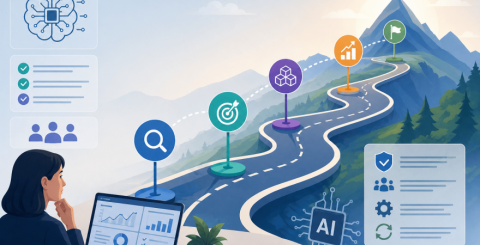
Many AI solutions die on the drawing board because people get caught in the hype. They jump to solutions before they fully understand the problem. Or they use "problem" and "goal" interchangeably. If the goal is to reduce churn by 25%, "using AI for churn prediction" is not the problem. It may be part of the solution. But the real problem isn't using AI at all. It's addressing the root causes of churn.
Run a real discovery phase before you draft anything
Before creating a roadmap, it's essential for the leadership teams to have a defined discussion about their objectives. While this may seem trivial, it hardly ever happens the right way.
What is often left out is an open evaluation of processes, existing issues, and the potential for existing solutions. By organizing a proper ai workshop at the beginning of this stage, cross-functional teams get to have a non-biased environment where they can bring up the real issues they face, rather than simply going with what the most convincing member in the room says.
The result of the discovery phase shouldn't be a list of potential suppliers. Instead, it should lay out a list of potential applications with each of them evaluated on two aspects: business impact and difficulty of implementation. The applications with high impact and low implementation difficulty are the applications you will want to focus on in the early stages.
Audit your data before you commit to anything
The key factor limiting AI performance is the quality of the data it's fed. This isn't a minor technicality that you can worry about later - it's the reality check that tells you whether what you're planning is actually do-able or just a nice idea.
According to Gartner, at least 30% of GenAI projects will be abandoned after proof of concept due to poor data quality, inadequate risk controls, or unclear business value. Every one of these executive-sponsored AI initiatives will demand not only high-quality data but also an understanding of risks concerning data use and its downstream effects.
That shift takes big plans (and even bigger budgets) off the table because you can't ensure data quality or anticipate related risks a few years in advance - you have to do it now. You can't afford to wait because, by then, you would already have burned through months of staff time and tens (if not hundreds) of thousands of dollars on consulting.
What's missing in these stranded exec edicts, abandoned pilot projects, and facepalm moments of surprised data pros, is this: a sobering recognition of data quality and risk controls as primary decision constraints in the timeline of your AI program. The roadmap can only be as big as answered data quality and risk control questions allow. Any blanks and the journey automatically ends early.
Build a tiered timeline, not a single launch plan
One of the mistakes we make structurally is that we treat an AI roadmap like a product launch "go big, ship, then onto the next thing." That may work for a marketing campaign, but if you're trying to develop a long-term alignment and agility engine, you need a multi-tier roadmap.
1. Tier 1: Immediate productivity. Automating reporting and alerts, summarizing documents and articles, generating first-draft content - these are the tier-1 use cases we've discussed that are relatively low-risk, can be implemented quickly, and give you the early "quick win" use cases to help build internal momentum and confidence.
2. Tier 2: Aligning and integrating with customer-level processes. These are tier-2 use cases that impact how you go to market, your customers, or in this case, the core operational and qualifying processes that create and deliver your products and services. Examples might be highly tailored recommendations and decision support integrated directly into your customers' processes or your products; integrated enterprise knowledge management, where AI is part of your employees' everyday decision-making process; or even opportunity analysis where AI's constantly analyzing your business for hidden pockets of potential growth and margin. These use cases take longer because you're now into serious change management work - they are exposing directly "at scale" for how the organization really makes decisions and shares knowledge.
3. Tier 3: Transformational outcomes. AI-driven product and capability development, predictive modeling, and enterprise-wide shifts in decision-making and knowledge management are where you begin to truly build a platform-based learning and decision-making business where the ROI on enterprise data and systems is directly influenced by the quality and quantity of the enterprise learning ecosystem. These aren't 90-day projects. They are 18- to 36-month commitments that only become viable after the tier-1 and tier-2 use cases have succeeded and stretched your organization to learn and adapt from them.
Make the feedback loop formal, not accidental
Where the rubber of AI implementation meets the road of the actual business is where, unfortunately, many projects fall apart. The most common reason (28%) for termination of an AI project is that it "wasn't meeting the business needs". Next on the list at 21% is "limited funding". In most cases lost funding can be traced back to not generating adequate business results because it wasn't meeting the business's needs. These are really two sides of the same coin.
It is easy to see how this can happen. The team working on the project is rarely the team that is tasked with using it to transform its activities. So misunderstandings and miscommunications are rife. A solution can lose funding simply because nobody knows it's crucial. Most commonly, no one knows it's crucial because there's been no mechanism for communicating that.
What alignment actually looks like
A strategic plan that actually gets followed to your long-term goals is most often a people and process document. The technology is the easier part. Getting organization buy-in, answering the data infrastructure questions, establishing attainable tiered goals, and incorporating steady feedback - those are the things that differentiate roadmaps that get implemented from those that get filed.
You lead with the strategy. Develop the environment to support it. And you worry about tools third.
Similar Articles

Most people encounter "swap" tools as a single category. A video goes in, a different person comes out, and the marketing rarely bothers to explain what was actually exchanged.

In recent years, fluctuating raw material costs, pervasive labor shortages, and other such challenges have created a perfect storm for manufacturing organizations.

A content idea can be clear in your head and still become difficult the moment it needs a visual.

Explore MLOps vs LLMOps and learn how enterprise teams deploy, monitor, and scale AI systems in 2026 with smarter workflows and reliable operations.
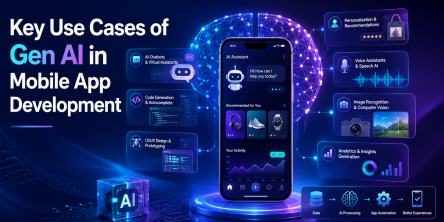
The digital world has always been evolving at a rapid pace. Ever since it first emerged. Take static applications, for example; their architecture is no longer agile enough to meet consumer expectations

A software product that took eighteen months to go from concept to launch five years ago is now expected to ship in a fraction of that time.

Most agentic AI projects fail to scale profitably because they work fine in a controlled demo but break down once they meet real production volume, messy data, and unpredictable user behavior

Adoption of AI recruitment automation across HR functions climbed from 26% to 43% in just two years, according to SHRM's State of AI in HR research.

Content creation has changed dramatically in recent years. Artificial intelligence tools now help writers produce blog posts, emails, product descriptions, and marketing materials much faster than before