

EcoVadis Rating Criteria: What Each Of The Four Pillars Actually Measures
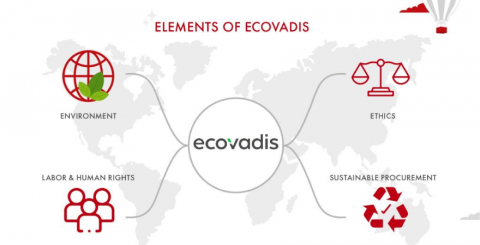
There's a moment most procurement professionals recognise: the supplier questionnaire arrives, and somewhere near the top is a request for an EcoVadis scorecard. If you've been in the B2B supply chain long enough, you've watched this shift from a nice-to-have to a hard requirement. Plenty of companies still treat their EcoVadis rating as a compliance checkbox rather than a strategic signal. That's a mistake worth unpacking.
EcoVadis doesn't evaluate your sustainability press releases. It evaluates your systems, your policies, and your demonstrated performance across four distinct pillars. Understanding what actually goes into that assessment changes how you approach it entirely.
1. The Environment Pillar Is More Nuanced Than Most Companies Expect
For the most part, when a business hears the phrase "environmental assessment", they think in terms of things like carbon emissions and recycling programmes. EcoVadis rating, however, takes a much more in-depth approach. The environment theme evaluates whether or not your business has formal policies in place concerning things like energy usage, greenhouse gases, water usage, biodiversity, and even environmental pollution in your area. Most importantly, however, they determine whether or not these policies have been documented, measured, and reported.
The logic behind the scoring system is to determine operationalisation over intention. A business that has a sustainability pledge out in the open but has yet to develop an internal reporting system in place will score lower than one that has a modest but measurable reduction programme in place.
Key areas evaluated under this pillar:
● Energy consumption and efficiency programmes
● Greenhouse gas emissions tracking and reduction targets
● Water usage management and pollution controls
● Formal environmental reporting mechanisms
For manufacturing companies, this pillar often determines the ceiling of their overall EcoVadis rating. For professional services firms, materiality weighting shifts significantly, which matters when you benchmark against peers.
2. Labour and Human Rights: Where Documentation Becomes a Differentiator
This pillar tends to surface the most significant gap between what companies believe they're doing and what they can actually demonstrate. EcoVadis evaluates working conditions; fair labour practices; health and safety programmes; and respect for fundamental human rights, including the prohibition of forced labour and child labour across the supply chain, not just within direct operations.
Documentation genuinely matters here. A robust health and safety programme that lives entirely in a supervisor's head won't satisfy this assessment. Neither will a code of conduct that was signed once and filed away. EcoVadis wants to see that policies are updated, communicated, and verifiable.
| What EcoVadis Looks For | Common Gap Found |
| Written health and safety policy | A policy exists but is not updated regularly |
| Human rights commitment | Applies internally only, not to suppliers |
| Fair labour documentation | Informal practices with no paper trail |
| Worker grievance mechanism | No formal channel exists |
In terms of UK businesses, this section intersects with legislative reporting requirements, such as those governed by the Modern Slavery Act. Businesses that have already developed a compliance structure to meet these types of requirements will be more comfortable with this pillar. The EcoVadis rating for this section is more a measure of organisational maturity than actual labour practices, a distinction that is not immediately obvious.
3. Ethics: The Pillar That Separates Serious Programmes From Performative Ones
The ethics theme covers anti-corruption, anti-bribery, responsible information management, and fair business practices. It's the pillar that most frequently surprises companies because they assume that not doing anything wrong is sufficient. It isn't.
EcoVadis will want to see evidence of proactive governance, which includes having a whistleblower policy in place, third-party audit rights, anti-corruption training in place for roles where this is applicable, and data security in place with a framework aligned to a standard.
The weightage assigned to data security has increased considerably over the last few assessment cycles, which is a general trend in the regulatory environment with regard to data privacy.
The other aspect that many companies are not aware of is that in the ethics theme, they are looking to see if your organisation expects ethical standards from its own supply chain. This is a key aspect where a strong internal governance system, whilst good, is not enough if it stops at your front door, as supply chain integrity is now a key driver of how your EcoVadis rating correlates with your true ethical stance, not just your internal compliance processes.
4. Sustainable Procurement: The Pillar With the Longest Lead Time
Sustainable procurement is often the last pillar companies get to and the one with the most downstream effects. This theme assesses whether or not your company has a formal supplier evaluation process in place that includes sustainability, how your company communicates to suppliers regarding environmental and social expectations, and whether or not supplier audits occur.
The challenge here is structural. It can take a week to update a policy document, but it can take months to build out a true sustainable procurement programme.
What EcoVadis measures in this pillar, in essence, is whether or not sustainability plays a role in the manner in which your company spends money. For an enterprise buyer, a strong score in this pillar means that your company views sustainability as an economic discipline, not just a communicative one. A poor score in sustainable procurement can hurt an otherwise good EcoVadis score in a manner that can be difficult to defend to customers who have drilled down to this level.
Conclusion
Your EcoVadis rating is not simply a straight average of those four themes. There are adjustments made based on industry and business size, so a logistics-based business will not face exactly the same assessment as a software-based business.The scoring system is from 0 to 100, and your position in percentiles represents where you are in relation to all other businesses in your industry that have gone through the assessment process.The difference between a 45 and a 65 is not simply 20 points, by the way. It's a difference in whether you meet a potential buyer's minimum requirement and whether you are a supplier they would want to work with.The common thread among businesses that see their EcoVadis rating improve year after year is a simple one: they view this assessment process as a management tool, not simply a periodic audit.And this change in perspective, from a reactive exercise to a proactive management tool, is exactly what this framework is designed to reward.
Similar Articles

Discover the hidden costs of running out of water on farms and worksites, and how better planning can reduce downtime, expenses and disruption.

Working with an electronics recycling company has become one of the most important decisions for households and businesses looking to dispose of old devices responsibly.

The world is rapidly developing, and the energy sector is in the middle of all these changes. For many years, individuals's homes, vehicles, and industries relied on oil and gas, but now, the shift is toward a green economy.

Discover efficient waste management solutions with advanced compaction technology, reducing costs, environmental impact, and boosting sustainability.

In a world increasingly attuned to environmental sustainability, the funeral industry is embracing practices that align with eco-conscious values. Eco-friendly funerals, or green funerals, are becoming a popular choice for those who wish to honor their loved ones while minimizing environmental impact.

In the last few years, more inclination has been observed towards a sustainable and environmentally responsible way of life. Many factors are driving this trend, some of which are as follows.

Water beads are non-edible colorful tiny balls that are made by a combination of water, acrylic acid, sodium hydroxide, and a water-absorbent polymer. They are extremely relaxing, soft, and small, roughly the size of a blueberry.
Many people are installing solar panels on their property to provide electricity. Doing so may improve your environmental footprint and could also lower your utility bills

Climate change is a global issue. Global warming isn't just down to other people's efforts. It is down to all of us. There are steps that we can take to slow it down somewhat. However, it will require an equally remarkable attempt by each of us. If we have any hope of combating what may well be humanity's greatest challenge yet.