

How Polarized Sunglasses Change the Way You See Your Phone Screen
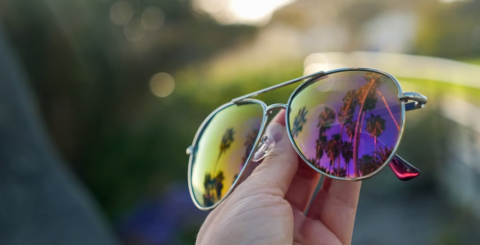
Almost everyone who has worn polarized sunglasses has had this exact moment: you put your phone up to check a text, or glance at your car's dashboard display, or look at a gas pump screen mid fill up, and the screen suddenly looks dark, patchy, or streaked with faint rainbow color. The instinctive reaction is to assume something broke. Your phone did not break, and neither did your sunglasses. This is a real, well documented optical interaction between two polarizing filters, the one built into your lenses and the one built into the screen itself, and almost nobody who has experienced it actually knows why it happens.
Two Polarizing Filters Meeting Each Other
Polarized sunglasses work by blocking horizontal light waves. Sunlight normally bounces off flat surfaces like water, pavement, or car hoods in a concentrated horizontal pattern, which is what creates blinding glare. A polarized lens, the kind built into well known lines like maui jim sunglasses, contains a filter that only lets vertically oriented light through, which cancels out most of that glare while letting the rest of the scene through normally. Most LCD screens, including phones, dashboards, and gas pump displays, are built the same way. A typical LCD sandwiches a layer of liquid crystal between two polarizing filters, and the light leaving the screen ends up polarized in a specific direction as a byproduct of how the display actually produces an image, not as some special anti-glare feature. Nelson Miller's breakdown of LCD construction covers this in more technical detail if you want the fuller explanation of why displays are built this way in the first place. The result is that looking at a screen through polarized sunglasses means looking at one polarizing filter through another, which is exactly the setup that causes the effect.
Why It's Sometimes Just Dark, and Sometimes a Rainbow
What you actually see depends on the angle between the two filters, and it changes the moment you tilt your head or rotate the phone. When the lens filter and the screen's filter happen to be aligned, the screen looks completely normal. As you rotate one relative to the other, less and less light gets through, and at the point where they sit at roughly a 90 degree angle to each other, the screen can go almost fully black. That's the simplest version of the effect, and it's the same principle used in optics labs to confirm that a lens is actually polarized in the first place. The rainbow version comes from a slightly different source: stress patterns baked into the glass or plastic layers of a screen during manufacturing, a phenomenon called birefringence. Younger Optics' explanation of this effect walks through how those internal stress patterns bend light unevenly across the surface, and when that unevenly bent light passes through a polarized lens, it splits into visible color bands instead of a flat dark patch. Older or lower cost screens tend to show this more noticeably, which is why the effect can feel more dramatic on a gas pump display than on a newer phone.
It's Not a Sign of Bad Sunglasses (or a Bad Phone)
This is worth saying plainly: the effect happens with essentially all polarized lenses to some degree, expensive or not, because it's inherent to how polarization itself works, not a manufacturing defect in either the lenses or the screen. A pricier pair of polarized sunglasses will generally give you better clarity, better UV protection, and a more comfortable overall lens, but it will not make this specific interaction disappear, because the cause sits on the screen's side just as much as the lens's side. What's actually worth paying attention to when buying sunglasses is a separate spec entirely: UV protection. Polarization and UV blocking solve two completely different problems, and one has nothing to do with the other. The American Academy of Ophthalmology is direct about this distinction, pointing out that polarized lenses reduce glare from reflective surfaces but do not, on their own, provide any UV protection unless the lens is specifically treated for it. A pair of sunglasses can be fully polarized and still offer poor UV protection, or vice versa, so the screen quirk described here should never be used as a stand in for judging lens quality overall. The only reliable way to confirm real UV protection is a label stating 100 percent UV protection or UV400, not the darkness of the lens and not how well it happens to handle glare off water or pavement.
What to Actually Do About It
The fix, when you need one, is almost always immediate and free. Tilting the phone screen slightly, or tilting your own head instead, changes the angle between the two filters enough to bring the screen back into a normal view within a second or two. It's a small adjustment that works reliably because the effect is purely angle dependent, not a fixed property of your specific pair of sunglasses. If you spend a lot of time checking screens outdoors, some people keep a second, non polarized pair around specifically for that reason, accepting slightly less glare reduction in exchange for a screen that always reads clearly. Pilots and heavy equipment operators often make exactly this tradeoff for work specifically, while still wearing polarized lenses for everyday driving. For everyday wear, though, most people simply get used to the small head tilt and move on, since the effect never actually indicates a real problem with the sunglasses themselves.
Conclusion
The next time a screen goes dark or rainbow colored through a pair of polarized sunglasses, it's worth remembering what's actually happening: two filters, each doing exactly what they were built to do, briefly working against each other instead of past each other. It's not a flaw in the phone and it's not a flaw in the sunglasses, and it's not something a more expensive lens or a newer phone will fully solve either, since the interaction is built into how both technologies work in the first place. If anything, it's a small, mildly annoying piece of proof that the lenses are blocking glare exactly the way they're supposed to. Once that clicks, the dark screen stops feeling like a problem to troubleshoot and starts feeling like a strange little side effect worth knowing the reason for, the same way it's satisfying to finally understand why a straw looks bent in a glass of water.
Similar Articles
Open any sunglasses customizer and you'll usually hit the same wall: six or eight lens tint swatches lined up side by side, all described in roughly the same marketing language, "classic," "versatile," "bold."

Discover why Barbas hats are trending in modern fashion, offering timeless style, premium craftsmanship, and versatile looks for every wardrobe.

Discover timeless ladies watches for every occasion, from casual wear to formal events. Explore elegant styles, modern features, and lasting sophistication.

Discover why streetwear caps became icons of modern fashion culture, blending individuality, music, creativity, and everyday style.

Fashion has always evolved alongside culture, technology, and consumer behavior. Over the years, trends have shifted from formalwear to casualwear, from oversized branding to minimalist aesthetics, and from mass production to intentional design.

When we think about putting together a standout outfit, we often focus exclusively on the pieces that everyone else will see. We spend hours curating the perfect collection of tailored trousers, crisp shirts, and statement accessories.

Explore mood-based perfume for women with scents designed to boost productivity, encourage relaxation, and spark romance for every occasion.

Learn how to style modern shoulder bags for polished evening looks with chic tips that elevate outfits for dinners, parties, and events.

Let's be honest, gift shopping for someone with refined taste can feel like navigating a minefield. You want something meaningful, not just another item collecting dust on a shelf. Here's where watches step in.