

Can Changing Your Location Lower a Flight Price? A Simple Way to Check

A flight costs one amount when you search from home. You change your online location, run the same search, and suddenly the fare is lower.
The result seems to support a popular theory: booking sites remember how often you search, work out that you want the flight, and raise the price. Switch to another country, the theory says, and you may see the “real” fare.
Flight prices move for plenty of other reasons. A cheaper fare class may have sold out. Taxes or currency rates may have changed. The booking site may also be displaying a different ticket type.
A lower price after changing your IP location could be useful. It could also be a coincidence.
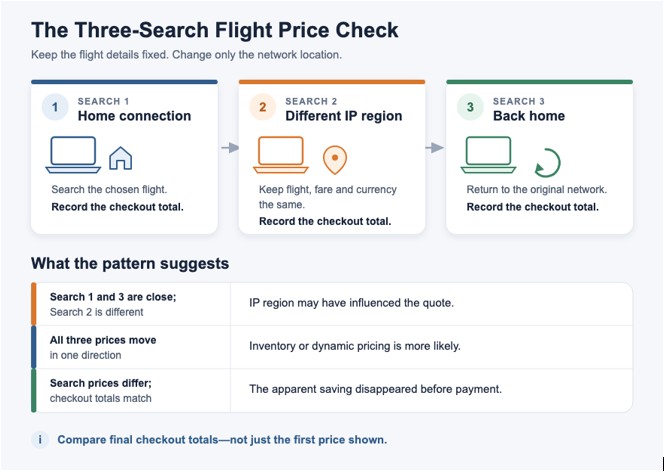
You can learn more by running the search three times. Record the fare on your normal connection, change your IP region and search again, then return to your original connection for one final search.
If the price difference does not appear again, there is little reason to keep guessing about what caused it.
Also Read: Smart Travel Planning: How to Balance Budget, Comfort, and Unique Experiences
Flight Prices Can Move While You Are Testing
Airlines often sell seats in several fare classes. Once the cheaper seats in one class are gone, the system begins offering the next available price. Two searches made a few minutes apart can therefore produce different results.
Airline offers are also becoming more flexible. The International Air Transport Association, or IATA, describes dynamic offers that can respond to market conditions and the details of a customer’s search. The route, travel date, cabin and number of passengers can all affect the offer returned.
Location and browsing behavior may play a role as well. The US Federal Trade Commission examined companies that provide pricing services to retailers. Its initial findings showed that location, browsing history and shopping behavior can be used to adjust prices, discounts or the order in which products appear.
That study covered several retail industries. It did not prove that a specific airline raises a fare because one person searched for it repeatedly.
Run the three searches within a short period. If you wait several hours between them, inventory and demand have more time to change. Any effect from your IP location becomes harder to separate from normal fare movement.
Choose One Flight and Keep the Details Fixed
Do not record the “cheapest flight of the day.” The first result may be a different departure time, fare class or airline when you search again.
Choose one flight. Write down its departure time, cabin and fare type. Use the same booking site, device and browser for all three searches.
Log out of your airline or booking account, then open a new private browsing window. Private browsing does not hide your network location. It does reduce the influence of older cookies and saved login sessions.
Keep that same private window open for all three searches. Clearing cookies halfway through the test or moving to another browser introduces another change.
The following details should remain the same:
- Origin, destination and travel date
- Flight and departure time
- Cabin and fare type
- Number of passengers
- Page language and display currency
- Baggage and seat choices
- Refund and change conditions
Continue to the final review page before payment. You do not need to enter card details or complete the purchase.
Record the search time, base fare, mandatory taxes, extra fees and final total. Include the refund and change rules too.
The large number on the search page is rarely enough. One booking site may show a fare without checked baggage. Another may add taxes earlier in the process. A lower starting price can become a higher total before payment.
Change the IP Region and Repeat the Search
After recording the first quote, connect to a different region through a VPN.
There is no country that always produces the lowest flight prices. A server that shows a cheaper fare for one route today may show no difference for another airline or travel date. The purpose of changing regions is to test one signal, not to find a secret global discount zone.
Before returning to the booking site, confirm that your public IP shows the new country or region. A VPN app may display “connected” even when the location is not the one you intended to test.
Run the same search in the private window you already opened. Keep the flight, passenger count, cabin, language and currency unchanged.
Do not clear cookies, sign into a different account or move to another booking site. If several conditions change at once, a lower price will tell you very little.
Some sites automatically change their language or currency after detecting a new region. Switch them back if possible. If the site will not allow that, make a note of the change. A smaller number in another currency does not guarantee a lower cost after conversion and card fees.
Record the second quote at the same point in the checkout process as the first one.
Return to Your
Starting Connection
Once you have the second quote, disconnect the VPN or return to your original network. You can check your IP address to confirm that both location changes took effect.
Now run the same search a third time. Keep every booking detail unchanged and return to the final review page.
Place the three totals next to one another.
If the first and third totals are close while the middle quote is consistently different, the IP region may have influenced the fare. For an expensive booking, repeat the full comparison later. A difference that appears more than once deserves more attention than a single screenshot.
If all three prices rise or fall in sequence, inventory or dynamic pricing is a more likely explanation. The fact that a VPN was active during the middle search does not show that it caused the change.
You may also find that the search pages show different prices while the final checkout totals are the same. Taxes may appear at different stages, or currency conversion may remove the apparent saving. The order of fare options can change too.
A consumer test cannot reveal an airline’s full pricing system. Booking sites use information that is not visible on the page, and seat inventory can change while the test is running. The three searches simply remove some of the easiest ways to misread a price change.
Make Sure the Lower Fare Can Be Purchased
A lower regional price is useful only if you can complete the booking under its stated terms.
Check whether the site requires a local billing address or a payment card issued in that country. Your bank may also charge a foreign transaction fee. A small fare difference can disappear after currency conversion, baggage fees and seat charges.
Read the refund and change conditions. A basic fare that cannot be changed or refunded may cost less than a flexible ticket for a clear reason. The two fares are not equal products.
Do not enter a false address to keep a regional price. Payment verification may fail, and incorrect details can cause more trouble if the flight is cancelled or you later request a refund.
The final total should include every mandatory charge. In the United States, for example, advertised airfares must include required government taxes and mandatory carrier charges. Optional services can still increase the amount you pay.
The fare worth comparing is the one you can actually purchase with acceptable conditions.
Your IP Location is Only One Signal
A VPN changes your public IP address and the approximate network location visible to a website. It does not automatically change your airline account, membership level or booking history.
Your browser language, device location, billing address, card country and time zone may still point to your usual region. The booking site may also keep information from the current session even after the IP changes.
A fare that remains the same does not show that location is never used. A fare that changes does not make IP location the only cause.
You only need four answers before acting on the result:
- Did the lower fare appear again?
- Could you complete the booking with your normal payment details?
- Was the final total genuinely lower?
- Were the baggage, refund and change conditions acceptable?
If all four answers are yes, the lower fare may be worth booking.
If the difference appears once and then disappears, stop switching through dozens of countries. The flight price may simply have changed while you were testing.
Similar Articles

The boons of digitalization and technology have leveraged the modern population with many advantages. Therefore, travelers are not lagging as well when it comes to booking their trips in the easiest and most affordable ways.

Can you predict if something is about to go wrong with your aircraft? The answer is "Yes." To an extent, you can predict a future problem in your aircraft. All you need to do is pay close attention to specific elements.

At a young age, most kids know what they want to do when they grow up. Some kids dream of becoming astronauts, blasting off into outer space, and exploring the far reaches of the cosmos. Some want to be racecar drivers, careening around racetracks at death-defying speeds, overtaking their opponents, and flying across the finish line in first place.

People have dreams, but not everyone is able to fulfill his dream. If you are also one of those who dream about becoming a pilot and flying aircraft in the sky, but could not do that due to eligibility issues or due to your family's consent was not there

So, you want to sell your house and move thousands of miles away, but you don’t really know how to plan everything out to the tiniest detail? If that’s the case with you, look no further because we’re here to help you out!