

MEAN vs MERN: Which Tech Stack Is Best For Your Business?
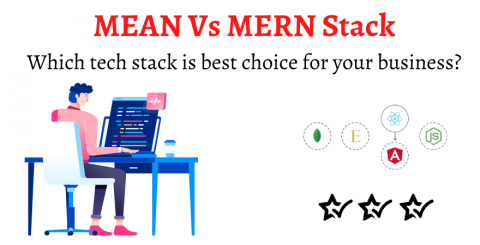
Today, web apps have become a necessity for businesses irrespective of their size and the industry vertical they reside in. Hence businesses are opting for web app development services to create web applications. New technologies are popping up to build scalable, high-performance, and robust web apps, and MERN and MEAN stack development solutions are on top of the list. Both of these tech stacks are the fastest growing technologies to develop top-notch web apps with extensive features and benefits. But one question that stuck in every entrepreneur’s mind is which one to choose for his/her project. So, here we will look at a comparison between these two tech stacks and try to figure out which will be the best stack for your business.
MEAN vs MERN: A quick comparison
Learning curve
When it comes to learning MEAN or MERN, it can be done by using varied materials and resources available online. Since both are JavaScript-based technology stacks, so having the knowledge of JavaScript would be a plus. And, there is no noticeable difference between MEAN and MERN from the technology point of view, so learning any of them can be a bit easier for learning the other. It all depends on two technologies that are AngularJS and ReactJS. Learning AngularJS is a bit tougher as compared to ReactJS.
Security and scalability
Both of the tech stacks are very reliable when it comes to security as they come with high-end security features. So, any of these tech stacks can be chosen when it comes to security. However, from the scalability point of view, MERN has a decent edge over the MEAN stack. Hence MERN is ideal for scalable web app development.
Architecture
The MERN stack focuses on providing smooth UI rendering. On the other hand, the MEAN stack comprises AngularJS that offers a well-structured framework to support MVC or MVW architecture. These kinds of architectures separate the UI and database with another framework in the middle like Controller, in the MVC. This is the reason MEAN is a preferred technology stack for many developers for business web apps.
Data flow
Data flow is another key point that differentiates between MEAN and MERN stack. AngularJS supports bidirectional data flow, so with the MEAN stack, you can get this feature. Consequently, any change in UI will cause an immediate change in the model state of a web app. ReactJS supports unidirectional data flow as a result any change in UI isn’t instantly reflected in the model state. Hence MEAN stack can be a perfect choice for small-scale projects and MERN can be a choice for large-scale projects.
Performance
Another important factor to differentiate between MEAN and MERN stack is the performance. If performance is all that matters to your then choosing the MERN stack should be the right decision for you. The key reason behind it is the ReactJS that is loaded with Virtual DOM that makes it high-performance. Virtual DOM is not an actual DOM but rather a copy of it. ReactJS updates elements on Virtual DOM and then creates the actual DOM based on it that expedites the app development and creates high-performance web apps. So, the MERN stack is good for high-performance web apps.
Wrapping up!
Choosing between the MEAN and MERN stack can be a difficult decision because they both come with their own advantages and disadvantages. In some cases, you can find MEAN doing the best job and in other cases, MERN would be more appropriate for your business solutions. However, you need to choose the right tech stack based on your requirements. You should closely examine all the features and benefits of each of these tech stacks to pick the best technology for your web app project. You can also rely on a reputed web development company to help you choose the right stack and build your web app.
Similar Articles

Energy efficiency is revolutionizing power distribution, leading to more sustainable and cost-effective energy systems.

Moving has a way of making even organized people feel scattered. One minute you’re labeling boxes. The next, you’re hunting for a receipt, calling the utility company, and wondering where the tape disappeared to.

Apple devices break more than owners expect. This guide shows the cases, screen protectors, and Apple Watch bands that stop cracks, scratches, and costly repairs, plus how to change apple watch band in under a minute.

The aviation industry is rapidly modernizing, shifting from reactive, paper-heavy maintenance to highly automated, predictive ecosystems.

Learn what makes users trust a health app instantly and discover the design, security, and user experience factors that drive long term engagement.
Learn how Thunderbolt 4 docking stations support multiple displays, deliver fast data transfer, and create a streamlined, productive workspace.

Learn how ML development teams measure ROI from machine learning investments by tracking revenue growth, cost savings, productivity gains, risk reduction, and long-term business outcomes.

Whether you are storing personal photos, school projects, work documents, or business files, cloud storage makes it easy to access your data from anywhere with an internet connection.

Find the best wireless label printer for your business. Compare the MUNBYN RW403B, RW405B, RW941B, and RW401AP to discover the right model for shipping, product labeling, print quality, and mobile workflows.