

How Hole Patterns in Pickleball Balls Influence Bounce, Spin, and Wind Resistance
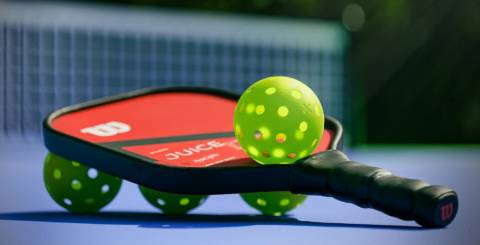
You just crushed a drive down the line, and it died halfway to the kitchen. Your opponent spun a return that seemed to float, then dropped like a stone. You blamed your paddle. You blamed the wind. But what if the ball itself was the real variable the entire time? Most players never think about the holes in a pickleball ball until something feels off.
Understanding hole patterns gives you a genuine edge. These small perforations control how pickleball balls fly, bounce, and respond to spin, and knowing the science behind them helps you choose the right ball and adjust your game accordingly.
How Hole Count and Placement Control Bounce in Pickleball Balls
A standard pickleball ball carries either 26 or 40 holes, depending on whether it is built for indoor or outdoor play. That number is not arbitrary. Fewer holes mean a denser shell with more surface area, which creates a livelier, higher bounce on hard gym floors. More holes reduce overall mass and rigidity, producing a faster, flatter bounce on outdoor concrete and asphalt courts.
Hole placement matters just as much as hole count. Manufacturers distribute holes evenly around the sphere to keep the center of gravity balanced. Any asymmetry makes the ball wobble in flight and bounce unpredictably, which is why tournament-grade pickleball balls must pass strict roundness standards before certification.
⭐ Featured Snippet
Hole patterns in pickleball balls directly affect bounce, spin, and wind resistance. Outdoor balls use 40 smaller holes for stability in wind. Indoor balls use 26 larger holes for a softer, higher bounce. Hole size, count, and spacing control airflow and shell rigidity across all playing conditions.
Why Hole Size and Spacing Determine Spin and Control
Larger holes increase aerodynamic drag and give the ball a slightly rougher flight path. This makes topspin and backspin shots easier to read because the ball moves more predictably through the air. Smaller, tightly spaced holes reduce drag and let the ball cut through the air faster, which compresses reaction time on both sides of the net.
Spin itself is a byproduct of surface contact, not just the paddle. When a ball has larger holes, the paddle face engages more solid surface area during contact, which transfers spin more efficiently. Smaller holes spread that contact energy across a greater number of edges, reducing the clean grip needed to generate heavy rotation. Experienced players often switch between a pickleball ball set designed for each condition to train both control styles.
Hole spacing also influences how the ball responds on the third-shot drop. A ball with tighter hole distribution holds its trajectory longer before dropping, while wider spacing creates earlier deceleration. Coaches who understand this teach players to recalibrate their soft game every time the playing surface or ball type changes.
Key Tip: When buying a pickleball ball set for outdoor play, look for 40 holes with a diameter between 0.282 and 0.354 inches. This range meets USA Pickleball standards and gives you consistent bounce and spin response across different court surfaces.
How Hole Patterns Reduce or Amplify Wind Resistance in Outdoor Pickleball
Wind is the biggest uncontrolled variable in outdoor pickleball, and hole design is the primary engineering tool used to manage it. Outdoor pickleball balls use more, smaller holes to minimize the surface area that wind can push against. This keeps the flight path straighter in crosswinds and reduces the balloon effect that causes balls to sail beyond the baseline.
The depth of each hole also plays a role. Shallower perforations create less turbulence around the shell, which stabilizes the ball at higher speeds. Deeper holes trap small pockets of air that create micro-drag, slowing the ball faster after peak velocity. This is why two balls with the same hole count can still behave differently depending on the manufacturer’s drilling specifications.
Plastic hardness works together with hole pattern to determine wind performance. A harder shell with small, shallow holes cuts through wind with the least resistance. A softer shell with large holes absorbs energy from the wind and decelerates quickly, making it better suited for controlled indoor rallies than outdoor competition. Choosing the wrong type for your environment does not just affect comfort, it actively changes your shot success rate.
Make Smarter Choices With Every Pickleball Ball You Pick Up
Hole patterns are not a cosmetic feature. They are the core engineering decision that controls how every pickleball ball performs in the air, off the court, and under competitive pressure. Bounce height, spin transfer, and wind stability all trace back to the number, size, spacing, and depth of those perforations.
Next time you pull a ball from your bag, take five seconds to check the specs. Are you playing outdoors in wind? Grab the 40-hole ball. Running an indoor clinic with beginners? The 26-hole version gives them better rally control. And if you want to try different styles to sharpen your own game, exploring a quality pickleball ball set built for different conditions is the fastest way to understand what the physics actually feels like in play.
Similar Articles

A genuinely engaging claw machine gives its players three things: a clear challenge, visible cont

Winter sports offer an unmatched adrenaline rush, but navigating icy terrains at high speeds requires more than just athletic skill.
You'd think buying a net would be easy. Pick one, click buy, done. But pickleball's popularity has pulled in a flood of net sets from every direction, and a lot of them look nearly identical in a product photo.

A sports news website doesn't crash on launch day. It cracks the instant a match reaches its final over. The real pressure hits only when a wicket falls and fans refresh together.

Young athletes burn out faster without proper recovery support. Learn how rest, nutrition, and recovery improve performance and prevent injuries.
Learn how to choose the perfect table tennis table. Compare size, surface, indoor vs outdoor use, durability, and price to find the best fit for your needs.

Test cricket is the oldest and most traditional format of the game. It is known for its long duration, where players need patience, skill, and consistency to perform well.

Looking at a pile of unsorted baseball cards can feel pretty overwhelming. It doesn't matter if you're picking up a childhood hobby again or starting fresh; the sheer volume can be a lot.

Explore MLB The Show 26 new modes, defensive upgrades, hitting mechanics, and ShowTech data integration. See how gameplay, Franchise, and Road to the Show have improved.